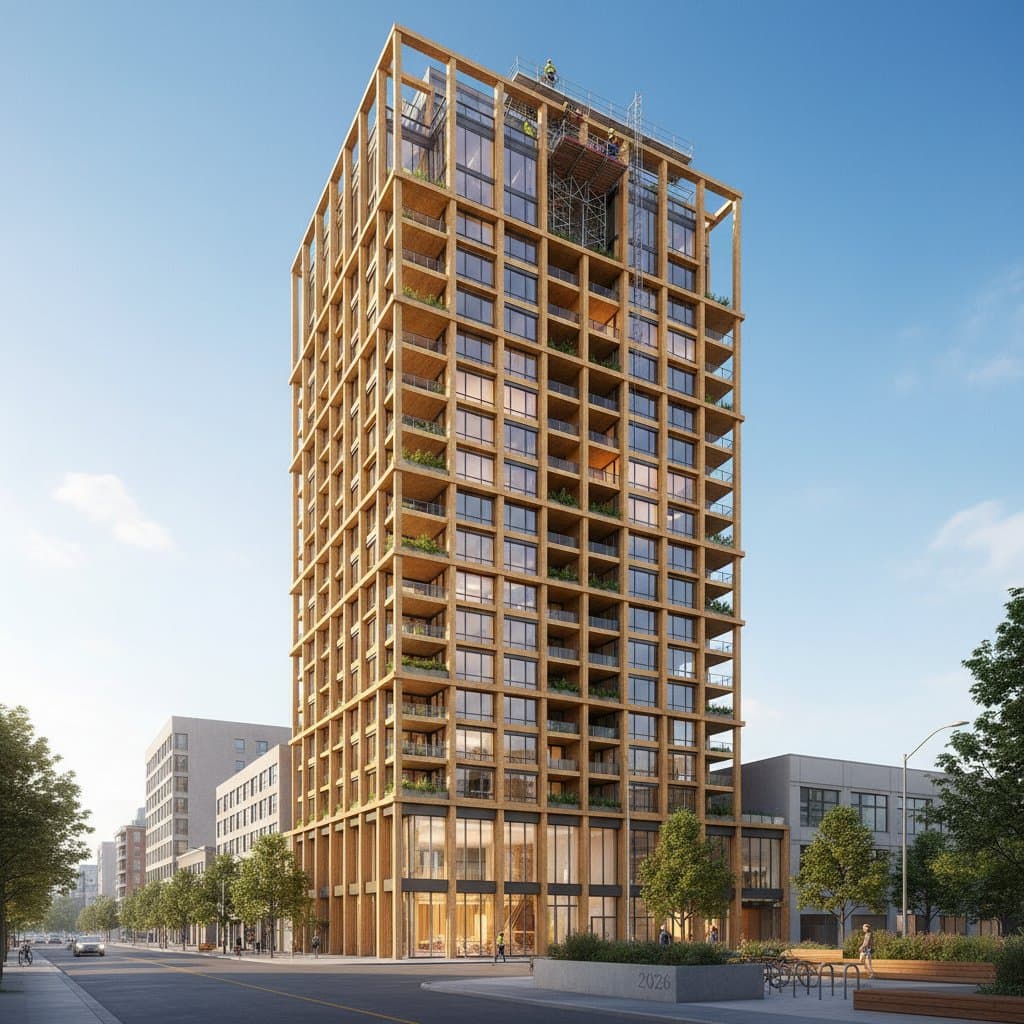
Mass Timber’s Emergence in Multi-Family High-Rises
Picture entering a contemporary apartment complex where the entrance carries a subtle cedar aroma, ceilings radiate a gentle wooden glow, and the atmosphere conveys coziness prior to any heating activation. Such is the understated appeal of mass timber. The initial visit to a mass timber structure left a lasting impression; it lacked the chill of concrete and the resonance of vacant corridors found in standard high-rises. Instead, it evoked a sense of familiarity, even without personal furnishings.
Wood traditionally served single-family homes or low-rise commercial spaces. However, the last ten years have altered this convention. Mass timber, particularly cross-laminated timber (CLT), now ascends urban landscapes with assurance. Developers of multi-family housing, architects, and urban planners embrace this material for its visual allure, ecological merits, and remarkable resilience. If one has ever touched exposed wood and questioned its capacity to support 20 stories, the response confirms its viability, reshaping urban construction practices.
Opportunities in Vertical Construction
The adoption of mass timber in high-rise residential projects transcends stylistic preferences. It addresses core desires in city dwelling: comfort, health, and ecological accountability. Conventional concrete and steel edifices often appear detached. They impose substantial carbon footprints. Timber sequesters carbon during growth and imparts a sensory ease that artificial substances seldom replicate.
Developers observe that prospective tenants favor the organic appearance and ventilated ambiance of timber-framed interiors. Entering a wood-structured area softens sound, alters illumination, and fosters a mild bond with the outdoors, promoting tranquility in routine activities. This affective attribute shapes architectural decisions beyond mere financial projections.
Understanding Mass Timber Fundamentals
Mass timber differs from conventional lumber. It encompasses engineered wood variants such as CLT, glue-laminated beams (glulam), and laminated veneer lumber (LVL). These involve bonding layered wood under compression with adhesives to form panels and beams that compete with steel in load-bearing capacity.
Key advantages for high-rises include:
- Structural integrity: CLT panels endure significant weights, qualifying them for multi-level applications.
- Fire performance: Thick sections char externally, shielding the interior for controlled, gradual combustion that complies with rigorous safety standards.
- Construction efficiency: Factory-prefabricated elements facilitate rapid on-site assembly, minimizing disruption, vehicle traffic, and project duration.
- Ecological advantages: Sourced renewably, timber supports sustainable harvesting to maintain supplies without exhaustion.
A site visit to an ongoing project revealed crews erecting a full CLT floor within days. The environment proved less noisy, tidier, and more composed than typical concrete operations, marking a notable advancement.
Constructing Intelligently for Height
Future developments will feature increased use of mass timber in mid- and high-rise residential initiatives. North American and European municipalities update codes to permit greater wood heights. This evolution prioritizes functionality over mere elevation.
CLT structures weigh considerably less than concrete equivalents, lowering foundation expenses. Reduced mass accelerates timelines, conserving funds and emissions. For multi-family developers, this formula yields benefits: diminished building costs combined with enhanced occupant satisfaction drive sustained profitability.
Architects leverage timber’s versatility for dynamic layouts. Expansive openings, cozy surfaces, and unveiled ceilings expand perceived space and individuality. A developer noted that occupants paid additional for rooms showcasing timber elements, likening the experience to an adult-oriented treehouse.
Adapting Design Workflows
Incorporating mass timber demands a revised approach compared to standard materials. Direct substitution of concrete with CLT proves insufficient. Designs must accommodate wood dimensions, fastening methods, and humidity safeguards.
Essential factors encompass:
-
Initial teamwork: Architects, engineers, and manufacturers collaborate from inception. Each connection, fastener, and component contributes to overall stability.
-
Accurate fabrication: Factory precision relies on comprehensive digital simulations for panel customization.
-
Humidity protection: Construction phases include protective enclosures and sequenced assembly to shield against precipitation or dampness.
-
Sound management: Timber conducts vibrations uniquely; solutions involve multi-layer floors, seals, and barriers to ensure unit seclusion.
-
Fire integration: Designs embed protective finishes and suppression features seamlessly.
Mass timber endeavors resemble crafting bespoke cabinetry more than foundational work. Components interlock precisely, yielding gratification as wood grains harmonize across surfaces.
Evaluating Financial Aspects
Mass timber shortens build times, yet initial material expenses may exceed those of conventional methods. CLT and glulam qualify as specialized items, necessitating logistical planning for transport. Nevertheless, many developers achieve equilibrium through assembly speed, labor reductions, and simplified foundations.
Estimates indicate CLT projects cost approximately ten to fifteen percent more than concrete parallels, though variations occur. Time efficiencies and mechanical savings often offset differences.
Proximity to suppliers influences economics. Areas with robust timber sectors, such as the Pacific Northwest, Quebec, and Scandinavian regions, streamline procurement and reduce prices. Emerging locales benefit from new facilities. For prospective projects, consult local engineered wood experts on specifications, shipping, and regulatory adherence during early planning.
Resident Experience in Timber Structures
Post-occupancy, benefits manifest promptly. Wood naturally balances moisture levels, improving air quality. Its thermal properties stabilize climates, lessening energy demands for climate control. Essentially, the structure adapts to inhabitants.
Observations show residents interact uniquely with these environments. They forgo excessive wall art, viewing the wood as inherent decoration. Subdued illumination accentuates textures. Maintenance reports highlight easier upkeep, with reduced dust on wood versus drywall, and infrequent repainting between leases, yielding annual savings.
Anticipating Mass Timber Advancements
Wider adoption will spur hybrid configurations blending wood with concrete or steel elements. These enable greater heights while preserving timber’s inviting qualities in habitable zones.
Ongoing studies will refine sound isolation, facade choices, and endurance metrics. Financial institutions gain assurance from accumulating performance data, facilitating larger wood-centric residential ventures.
Implementing Mass Timber Projects
For multi-family initiatives contemplating mass timber, initiate with exploration. Tour an existing CLT facility. Observe the subdued ambiance contrasting concrete reverberations and how illumination interacts with wood. Discuss replication feasibility with your architectural team.
Partner with regional providers versed in operations. Involve structural specialists promptly. These steps ensure alignment with objectives, delivering structures that blend efficiency with human-centered design.
Sustaining the Timber Legacy
Post-completion inspections reveal persistent serenity. Individuals linger to feel surfaces. Youth follow wood patterns with fingers. Amid urban intensity, these areas anchor inhabitants. Mass timber thus bridges contemporary demands with enduring natural ties, proving that building can harmonize productivity and empathy.