Understanding the 2-1 Buydown and Its $40,000 Savings Potential for 2026 Mortgages
Homebuyers face elevated interest rates that strain budgets, yet innovative financing options like the 2-1 buydown emerge to address these challenges. This strategy delivers substantial early savings, often totaling around $40,000 on a typical mortgage. Builders and lenders increasingly promote it to stimulate sales and help buyers transition into homeownership more comfortably.
Defining the 2-1 Buydown
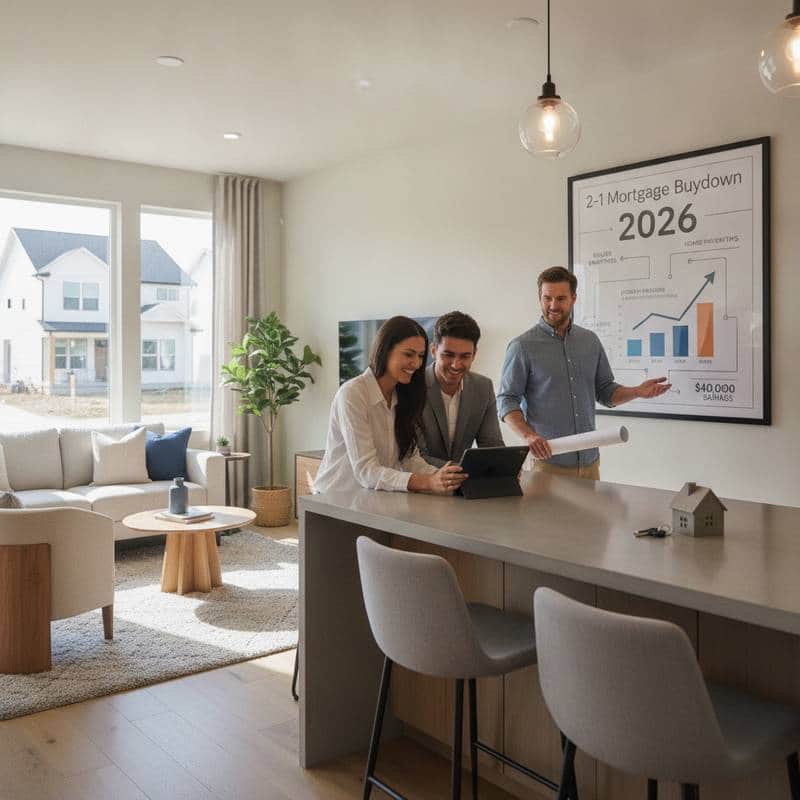
A 2-1 buydown functions as a temporary reduction in the interest rate on a fixed-rate mortgage. In the first year, the effective rate decreases by two percentage points below the note rate. The second year features a one-percentage-point reduction, after which payments revert to the full note rate starting in year three.
This arrangement allows borrowers to manage lower initial payments while securing a long-term fixed-rate loan. Funding typically comes from the builder, lender, or seller, who prepay interest costs equivalent to the rate discount. Borrowers receive the benefit without altering the loan principal or terms.
Reasons Builders Promote It in Today's Market
Elevated mortgage rates reduce buyer affordability, prompting builders to deploy incentives like the 2-1 buydown to maintain momentum. This approach preserves home prices while providing immediate payment relief, encouraging purchases in new developments.
Many builders integrate it into standard financing packages for communities. It counters market hesitation by aligning with buyer needs for financial flexibility amid economic uncertainty. The result sustains inventory movement without direct price concessions.
Calculating the Financial Benefits
Consider a $400,000 mortgage at a 7% note rate, yielding a standard monthly principal and interest payment of about $2,661. With a 2-1 buydown, the first-year payment drops to approximately $2,200, reflecting a 5% effective rate. The second year rises to $2,430 at 6%, before returning to $2,661.
Over two years, these adjustments save roughly $8,772 in payments, though total interest prepaid by the funder can approach $40,000 depending on loan size and rates. Use online mortgage calculators to model specifics for your scenario. These funds free up resources for home improvements, emergency savings, or debt reduction during the adjustment period.
Potential Drawbacks to Consider
The primary risk involves the payment increase after year two, which could strain budgets if income remains stagnant. Buyers must project future financial stability to avoid surprises. Review your long-term plans, such as career advancement or relocation, before committing.
Examine funding sources carefully, as some arrangements may involve lender credits that affect closing costs or require borrower contributions. Request a detailed amortization schedule and total cost analysis from your lender. Transparency ensures the incentive aligns with your overall financial strategy.
Ideal Scenarios for Utilizing a 2-1 Buydown
This option suits buyers with anticipated income growth, such as recent graduates or professionals in expanding fields. It also benefits those planning to refinance when rates decline, using early savings to build equity or cover closing fees.
For new construction purchases, it bridges the gap between current high rates and desired affordability. Evaluate it alongside other incentives, like closing cost assistance, to maximize value. Consult a mortgage advisor to compare against alternatives like adjustable-rate mortgages.
Building Equity and Stability Post-Buydown
After the initial period, full-rate payments support steady equity accumulation and long-term financial security. The two-year buffer allows time to adapt to homeownership expenses, from maintenance to utilities.
This financing tool underscores the importance of strategic planning in real estate. By easing entry into the market, the 2-1 buydown fosters confidence and positions buyers for future opportunities, such as upgrades or investments.