Key Takeaways
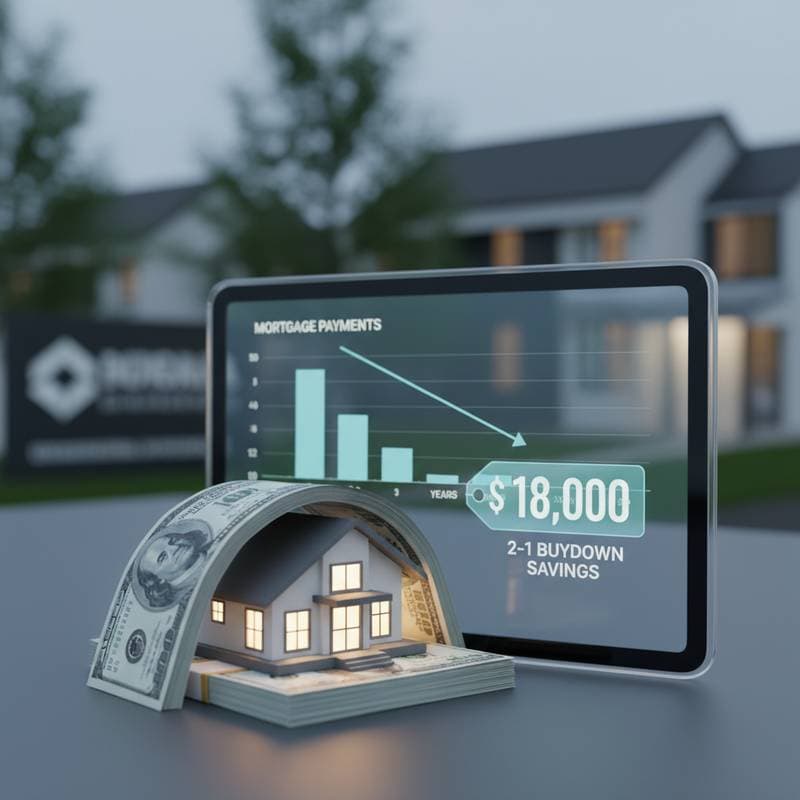
- A 2-1 buydown delivers approximately $18,000 in savings on mortgage payments during the initial two years.
- This method provides a temporary interest rate reduction to enhance affordability at the start of homeownership.
- Builders or lenders typically fund the buydown, allowing borrowers to benefit without direct upfront expenses.
Understanding the 2-1 Buydown
A 2-1 buydown offers a temporary reduction in the mortgage interest rate for the first two years of the loan term.
The structure operates as follows:
- During year one, the rate decreases by two percentage points below the approved rate.
- In year two, the rate increases to one percentage point below the approved rate.
- Starting in year three, the rate reverts to the full approved level.
This gradual adjustment allows borrowers to acclimate to homeownership costs before reaching the standard payment amount.
Example:
Consider an approved rate of 7 percent. Under a 2-1 buydown, payments reflect a 5 percent rate in year one, a 6 percent rate in year two, and the full 7 percent rate thereafter. These reductions provide substantial early savings while borrowers manage additional home-related expenses.
Calculating Potential Savings
To illustrate the financial impact, examine a practical scenario. Assume a purchase of an $800,000 home with a 10 percent down payment, resulting in a $720,000 loan at a 7 percent rate. The standard monthly principal and interest payment would total approximately $4,790.
With a 2-1 buydown:
- Year one at 5 percent yields a payment of about $3,866 per month.
- Year two at 6 percent yields a payment of about $4,316 per month.
- Year three onward returns to $4,790 per month.
The cumulative savings over the first two years amount to roughly $18,000. These funds can support home improvements, furnishings, or other initial costs associated with property ownership.
Benefits of a 2-1 Buydown
This financing tool offers several advantages for new homeowners:
- Early financial relief: Reduced payments provide immediate cash flow during the settling-in period.
- No direct cost to borrower: Funding often comes from the builder or lender as a sales incentive.
- Improved qualification: Lower initial payments assist in meeting debt-to-income requirements.
- Refinancing opportunities: Borrowers gain flexibility to refinance at potentially lower rates before the buydown expires.
- Budgetary preparation: Savings create a buffer for expenses like landscaping or unexpected maintenance.
Tips for Implementing a 2-1 Buydown
Tip 1: Consult Your Lender Early
Discuss the 2-1 buydown option with your lender before selecting a property. Inquire about available programs and compatibility with your loan type.
Some lenders or loan products may restrict builder-funded buydowns, so early clarification prevents complications during the application process.
Tip 2: Clarify Funding Details
Determine who covers the buydown costs, whether the builder, lender, or another party. Review any conditions attached to the incentive.
This knowledge ensures the benefit aligns with your financial plan and avoids hidden fees or limitations.
Tip 3: Prepare for the Rate Adjustment
Anticipate the payment increase after year two by projecting your budget accordingly. Factor in expected income growth or debt reduction.
Use the initial savings to establish an emergency fund or accelerate other debt payments, ensuring a seamless transition to the full rate.
Mechanics of the 2-1 Buydown
The buydown functions through an escrow account established by the builder or lender. This account holds funds equivalent to the interest differential between the reduced and full rates.
Monthly, the borrower pays the lower amount, and the lender draws from escrow to cover the remaining interest. Once the escrow depletes at the end of year two, payments adjust to the original rate.
This process maintains lender profitability while delivering borrower savings, operating with full transparency throughout the loan term.
Addressing Common Misconceptions
Several misunderstandings surround buydowns. Consider the following clarifications:
-
Misconception: The offer seems unrealistic.
In reality, it represents a legitimate incentive where a third party subsidizes temporary costs, commonly applied in new construction financing. -
Misconception: Payments increase abruptly.
The adjustment occurs progressively, with the exact schedule disclosed prior to closing, eliminating unexpected jumps. -
Misconception: It influences loan approval.
Lenders base qualification on the full note rate, confirming the borrower can handle the permanent payment level.
Essential Questions to Ask
When engaging with lenders or builders, pose these questions to gain clarity:
- Who funds the buydown?
- Is it possible to pair the buydown with additional incentives?
- What are the precise payments for years one, two, and three?
- Do restrictions apply to refinancing during the buydown period?
- What occurs if the home sells before the buydown concludes?
Request all details in writing to verify the terms and calculations.
Strategies for Long-Term Success
- Track savings systematically. Direct the payment differences into a dedicated account to build reserves for future adjustments.
- Monitor market conditions. Maintain strong credit and limit new debt to position for advantageous refinancing if rates decline.
Securing Your Mortgage Savings
A 2-1 buydown empowers buyers to enter homeownership with greater confidence and financial flexibility. By leveraging this tool, individuals can allocate early savings toward establishing a stable foundation. Consult professionals to integrate it into your homebuying strategy and maximize its value.