Understanding the 2-1 Buydown and Its Potential to Save $40,000 on 2026 Mortgages
Picture yourself reviewing mortgage options for your ideal home. The purchase price aligns with your budget, and the location suits your needs, yet the projected monthly payments cause concern. You ponder adjustments to your lifestyle or delaying the purchase in hopes of lower interest rates.
A 2-1 buydown addresses this challenge directly. This financing approach temporarily reduces your interest rate for the first two years, providing immediate relief on payments while preserving your overall financial strategy. Buyers who adopt this method often realize substantial savings, sometimes reaching $40,000 over the buydown period.
This article details the concept, its operations, and evaluation criteria to determine its suitability for your situation.
Current Challenges in Homebuying
Homebuyers today navigate a complex landscape. Purchasing now means committing to elevated interest rates, while waiting carries the risk of rising property values. This decision demands careful consideration.
Rising rates increase monthly obligations significantly, even with stable home prices. These added costs, combined with property taxes, insurance, and maintenance, strain finances. The 2-1 buydown offers a buffer, mitigating the impact of higher rates during the early adjustment phase of homeownership.
View it as a transitional support, bridging current market conditions to anticipated future improvements in rates.
Step-by-Step Breakdown of the 2-1 Buydown Process
The 2-1 buydown involves prepaid interest to subsidize lower payments initially. Follow these steps to implement it effectively:
-
Determine the funding source: The buydown requires upfront payment for the interest discount. Sellers or builders frequently contribute this as an incentive to close the sale. Lenders may also provide it through special offers.
-
Deposit funds into escrow: The lender holds these funds in an escrow account. Monthly, the account covers the gap between your reduced payment and the actual amount due at the full rate.
-
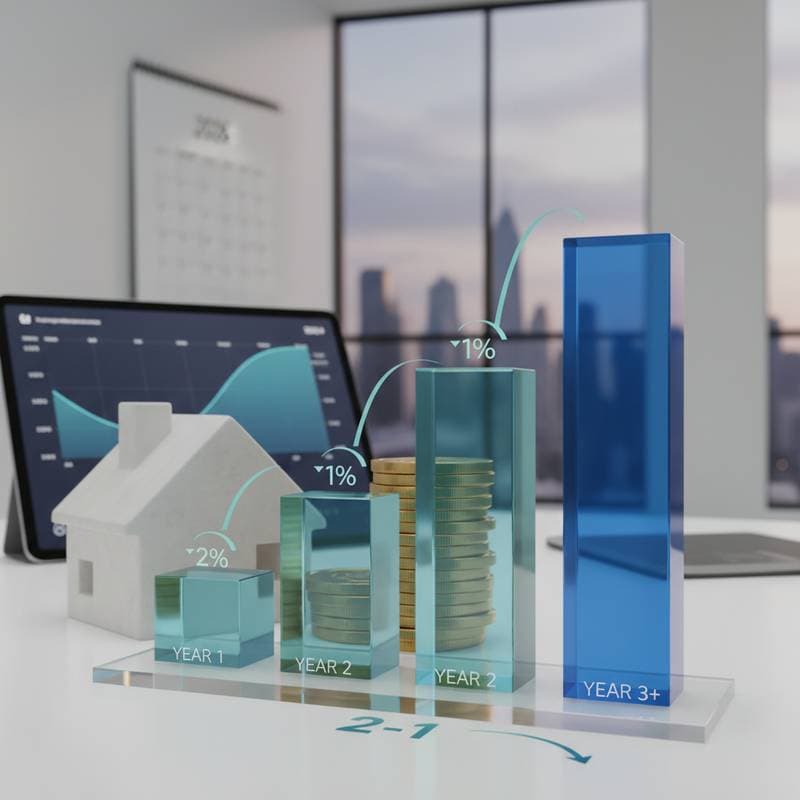
Experience gradual payment increases: In year one, your rate drops by two percentage points, lowering payments accordingly. Year two features a one-point reduction. From year three onward, payments reflect the original full rate for the loan's duration.
-
Consider refinancing opportunities: Should rates decline, refinance before the buydown expires to secure a permanently lower rate. This flexibility enhances the strategy's appeal.
This structure benefits buyers anticipating income growth, intending to refinance, or requiring temporary financial ease during home setup.
Key Considerations and Potential Drawbacks
While effective, the 2-1 buydown demands thorough evaluation. Approach it with realistic expectations.
-
Limited duration: The rate reduction applies only to the first two years. Develop a clear plan for handling full payments thereafter.
-
Qualification on full rate: Lenders assess affordability using the permanent rate, confirming your ability to sustain payments post-buydown.
-
Refinancing uncertainties: Persistent high rates or personal financial shifts could prevent refinancing, leaving you with the original rate.
-
Dependency on negotiations: Success hinges on seller or builder agreement. Not all parties will concede to funding the buydown.
Treat the 2-1 buydown as a strategic aid within a broader plan, rather than a standalone solution. It suits those with forward-thinking financial goals but requires caution for short-term reliance.
Comparing the 2-1 Buydown to Alternative Strategies
Evaluate the 2-1 buydown alongside other options to identify the best fit:
-
Permanent buydown: Involves a one-time payment to reduce the rate indefinitely. Ideal for long-term homeowners seeking lasting savings.
-
Adjustable-rate mortgage: Provides an initial low rate that may rise later, introducing variability. The 2-1 buydown offers predictability, with known payment escalations.
-
Seller credits for closing costs: Redirect buydown funds to offset fees, preserving liquidity for immediate home needs like repairs or upgrades.
Selection depends on your residency duration and rate forecast confidence. Shorter stays may favor adjustable options, while longer commitments align with permanent reductions.
Calculating Potential Savings
Estimate savings using mortgage calculators available online. Enter your loan details at the full rate, then simulate the two-point reduction for year one and one-point for year two.
Compute monthly differences and annualize by multiplying by 12. For a $300,000 loan at 7% interest, a two-point drop to 5% in year one could save approximately $300 monthly, or $3,600 yearly. Year two at 6% might save $150 monthly, totaling $1,800.
Over two years, these figures accumulate to significant relief, potentially $5,400 or more, depending on loan size. Factor in your specific scenario for precise projections. Even modest monthly gains compound into meaningful cash flow for other priorities.
Steps to Negotiate and Implement a 2-1 Buydown
To secure a 2-1 buydown, integrate it into your offer strategically. Start by discussing with your lender the feasibility and costs involved.
Request seller concessions explicitly in purchase agreements, highlighting mutual benefits like faster closings. If building new, inquire about builder incentives during initial consultations.
Consult a financial advisor to model long-term impacts, ensuring alignment with your budget and goals. Document all terms clearly to avoid misunderstandings.
Long-Term Financial Benefits and Final Thoughts
Beyond immediate savings, the 2-1 buydown fosters stability during home transition. It allows focus on building equity without early financial pressure.
Pair it with disciplined budgeting to prepare for rate normalization. This proactive approach maximizes affordability and positions you for future opportunities like refinancing.
Ultimately, the 2-1 buydown empowers informed homebuying decisions, turning market challenges into manageable steps toward ownership success.