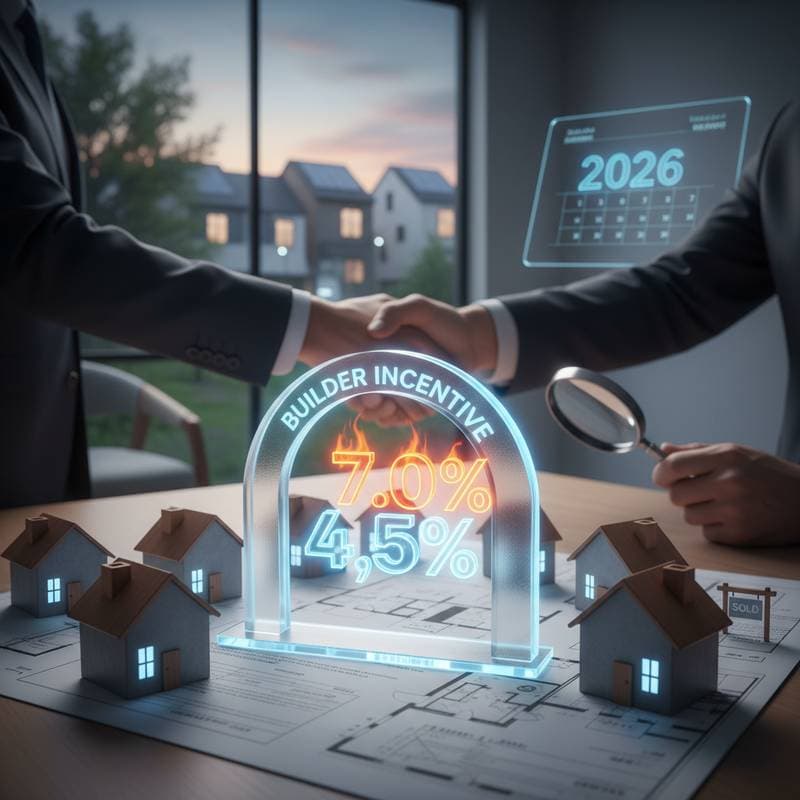
The Emerging 2026 Builder Competitions on Rate Buydowns
New home listings reveal a notable trend. Builders now extend offers beyond standard upgrades like granite countertops or enhanced flooring. They propose to buy down mortgage rates, a tactic that signals a profound evolution in home sales and financing strategies. This development paves the way for anticipated competitions among builders centered on rate buydowns.
Understanding Rate Buydowns
A rate buydown occurs when a builder or lender provides a lump sum payment to reduce the mortgage interest rate for a limited period. This adjustment typically spans one, two, or three years. During this interval, monthly payments decrease, facilitating loan qualification or enhancing early affordability for homeowners.
Consider it an upfront mortgage discount funded by the builder to boost appeal amid elevated rates. Builders may incorporate this expense into the home price or modify other incentives. For numerous buyers, this approach serves as essential support.
Reasons Builders Emphasize Buydowns
Builders view rate buydowns as a vital tool in a market dampened by high mortgage rates. Rather than implement widespread price reductions, which might damage brand perception or resale potential, buydowns offer adaptable solutions. These allow promotion of affordability without substantial concessions.
Psychology plays a key role. Buyers prioritize monthly payments over total expenses. A reduced rate delivers a stronger perceived advantage than a comparable price cut. Builders leverage this insight to sustain visitor interest in model homes.
As adoption grows, rivalries intensify. Certain builders provide extended buydowns, while others combine them with credits for closing costs or complimentary enhancements. The result is a contest for buyer loyalty and promotional superiority.
Projections for Builder Competitions
Envision adjacent neighborhoods under construction by multiple builders. One extends a 2-1 buydown, another a 3-2-1 buydown, and a third eliminates interest for the initial year. Such scenarios ignite promotional escalations. Buyers begin to regard these incentives as baseline expectations, compelling builders to innovate further.
This rivalry benefits buyers temporarily through enhanced financing options and superior terms. However, compromises arise. Builders may reduce material quality or parcel dimensions to balance incentive expenses. Reliance on affiliated lenders can restrict buyer choices.
The term builder competitions aptly describes the underlying pressures. Participants strive to maintain sales volumes while safeguarding margins, positioning rate buydowns as the primary arena.
Implications for Current Home Shoppers
For those pursuing new construction, this pattern offers advantages if approached with diligence. Consider these essential points:
- Determine the buydown duration. Temporary arrangements lead to rate increases later; clarify the timing and payment impact.
- Evaluate overall expenses beyond initial payments. An elevated home price to finance the incentive may diminish long-term worth.
- Inquire about permanent buydowns. These involve higher initial funding but yield consistent reductions.
- Assess lender options. Builder-preferred providers suit some needs, yet independent lenders may replicate or improve terms upon review.
- Align with personal plans. Temporary buydowns suit refinancing strategies post-rate declines; permanent ones fit extended occupancy.
Mechanics Behind Builder Strategies
Builders sustain these offerings through profit margins and collaborations. Negotiations with favored lenders or affiliates yield cost reductions. Integrating financing with building processes enables efficient cost allocation. Examples include minimized marketing budgets or leveraged bulk acquisitions to counter buydown outlays.
Lenders occasionally share expenses, anticipating prolonged client retention. Success hinges on buyers avoiding early refinances. This framework forms an interconnected system where stakeholders contribute modestly to secure transactions.
Broader Market Influences
Widespread buydowns extend beyond buyer attraction. They affect pricing and valuation norms. Professionals such as appraisers and agents must quantify these incentive values. A property sold with a significant buydown may appear at full market price, though financing effectively subsidizes it.
Resale market participants face challenges. New homes with buydowns project greater affordability compared to unmodified resales, despite equivalent true costs. This dynamic may prompt resale price adjustments or novel seller incentives.
Rate buydowns transcend mere finance; they mold value perceptions, exerting considerable influence.
Strategies for Engaging with New Construction
Preparation enhances outcomes when examining builder options. Implement these approaches:
- Research thoroughly. Contrast proposals from various builders and request written incentive summaries.
- Calculate scenarios. Employ mortgage tools to project payments after buydown expiration.
- Bargain effectively. Builders anticipate discussions; exchange incentives to match preferences.
- Consult experts. Skilled buyer agents decode incentive structures and identify concealed expenses.
Sustaining Affordability Over Time
Upon settling into a new residence, the buydown provides initial relief with controlled payments and familiar surroundings. As the rate adjusts upward, financial preparedness ensures smooth adaptation. Proactive budgeting transforms potential challenges into manageable transitions.