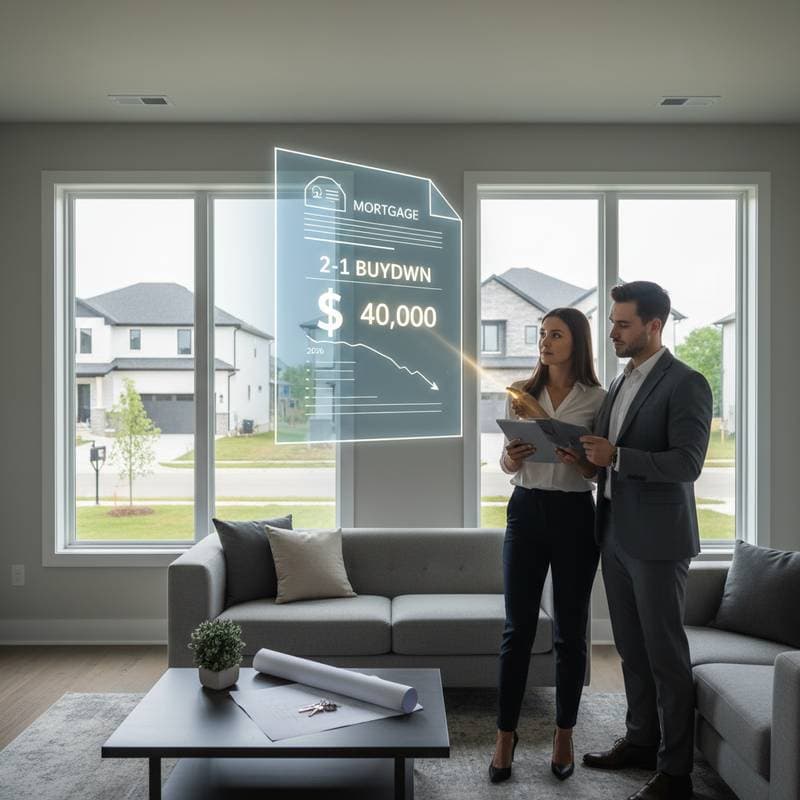
Save $40,000 on Your 2026 Mortgage with a 2-1 Buydown
Picture entering your new home with keys in hand and discovering that your initial mortgage payments are several hundred dollars lower each month than anticipated. This financial relief allows for investments in furnishings or outdoor enhancements that personalize the space. A 2-1 buydown provides exactly this advantage, serving as an effective strategy for reducing costs on new mortgages.
Homebuyers today encounter elevated interest rates that increase monthly obligations. Even with solid credit and a substantial down payment, financial pressures mount quickly. Incentives such as the 2-1 buydown address these concerns by temporarily adjusting rates to support smoother entry into homeownership.
Understanding the 2-1 Buydown Mechanism
A 2-1 buydown temporarily reduces the interest rate on a mortgage for the initial two years. This adjustment originates from prepaid interest funds that lower the effective rate during this period.
The structure operates as follows:
- First year: The interest rate decreases by 2 percentage points below the permanent rate.
- Second year: The rate decreases by 1 percentage point below the permanent rate.
- Third year onward: Payments revert to the original permanent rate.
For a permanent rate of 6.5 percent, payments in the first year reflect a 4.5 percent rate, the second year a 5.5 percent rate, and subsequent years the full 6.5 percent. These reductions can accumulate to approximately $40,000 in savings over the two years, based on loan size and terms.
Reasons Builders and Lenders Provide Buydowns
Builders employ buydowns to encourage purchases amid rate uncertainties. They fund the upfront cost, which covers the interest differential for the early years, without altering the home's base price.
Lenders may extend similar options independently. This arrangement benefits all parties by facilitating transactions while allowing buyers to acclimate to full payments as their finances stabilize post-move.
Calculating Potential Savings
Consider a $500,000 home purchase with a 10 percent down payment on a 30-year fixed-rate mortgage at 6.5 percent. The loan amount totals $450,000.
Under a 2-1 buydown:
- Year 1 (4.5 percent): Monthly principal and interest payments approximate $2,280, a reduction of about $600 from the full rate payment of $2,880.
- Year 2 (5.5 percent): Payments rise to around $2,560, saving approximately $320 monthly.
- Two-year total: Savings reach nearly $40,000, including lower interest accrual.
These funds support essential expenses such as home improvements or building reserves.
Additional Advantages for New Homeowners
Relocating incurs unforeseen costs, from utility setups to minor repairs. Lower initial payments provide flexibility to address these without immediate budget strain.
This period enables establishment of household routines and completion of personalization projects. By the time payments increase, financial footing strengthens, reducing adjustment challenges.
Ideal Scenarios for a 2-1 Buydown
This option suits buyers anticipating income growth or planning to refinance as rates decline. It proves particularly valuable when builders cover the funding, delivering savings at no extra buyer cost.
For long-term owners, evaluate overall loan economics. Compare buydown expenses against alternative uses for upfront capital, ensuring alignment with financial goals.
Key Considerations Before Proceeding
Verify ability to afford full payments post-buydown. Funding sources matter: builder or seller contributions maximize value, while self-funding requires cost-benefit analysis.
Review lender-specific terms, including eligibility and structure variations. If refinancing looms, assess timing to avoid overlapping fees or missed opportunities.
Steps to Implement a 2-1 Buydown
Initiate discussions with your lender upon rate exploration. Inquire about buydown availability and integration into your loan application.
Consult builders or sellers, especially in new construction, for sponsored programs. Examine loan estimates for transparent disclosure of costs and funding.
Confirm payment projections across years and align with personal timelines. Negotiate complementary incentives, such as closing cost reductions, to enhance overall terms.
Regional Availability of Buydown Programs
Many builders collaborate with local lenders to offer buydowns. In areas like the Pacific Northwest, major developers such as DR Horton and Lennar include these on select properties.
Community banks and credit unions often provide tailored options. Direct inquiries reveal unadvertised flexibility, particularly during competitive markets.
Integrating Savings into Daily Home Life
Reduced payments expand monthly budgets for practical upgrades. Allocate funds toward appliances, professional cleaning, or cosmetic enhancements that elevate comfort.
These investments accelerate the transition from new purchase to cherished residence. Over time, such choices compound the buydown's impact on quality of life.
Essential Questions for Lenders
Approach lender consultations with targeted inquiries:
- Do you provide temporary buydown options, such as 2-1 structures?
- Is funding available from sellers or builders?
- What are the projected payments for each year?
- Are fees or qualification restrictions applicable?
Request amortization schedules for visual comparison of scenarios. Clear explanations and detailed projections build confidence in decisions.
Detailed Financial Illustration
For a $600,000 new build with 10 percent down, the $540,000 loan at 6.5 percent yields monthly payments of about $3,410.
With buydown:
- Year 1 (4.5 percent): Payments fall to approximately $2,740.
- Year 2 (5.5 percent): Payments adjust to around $3,070.
- Cumulative benefit: Over $16,800 in direct payment reductions, equating to $40,000 total value when including interest savings and financial flexibility.
This buffer addresses relocation expenses or discretionary spending.
Preparing for Payment Adjustments
Anticipate the third-year increase by building habits early. Reserve a portion of initial savings monthly to simulate full payments.
In the second year, voluntarily pay the higher amount and save the difference. This practice ensures seamless adaptation and maintains financial security.
Realizing Long-Term Value
A 2-1 buydown empowers strategic homeownership from the outset. It facilitates gradual financial integration, accommodating life transitions like career shifts or family expansions.
Ultimately, this tool transforms early challenges into opportunities for growth, solidifying the home as a stable foundation for future aspirations.