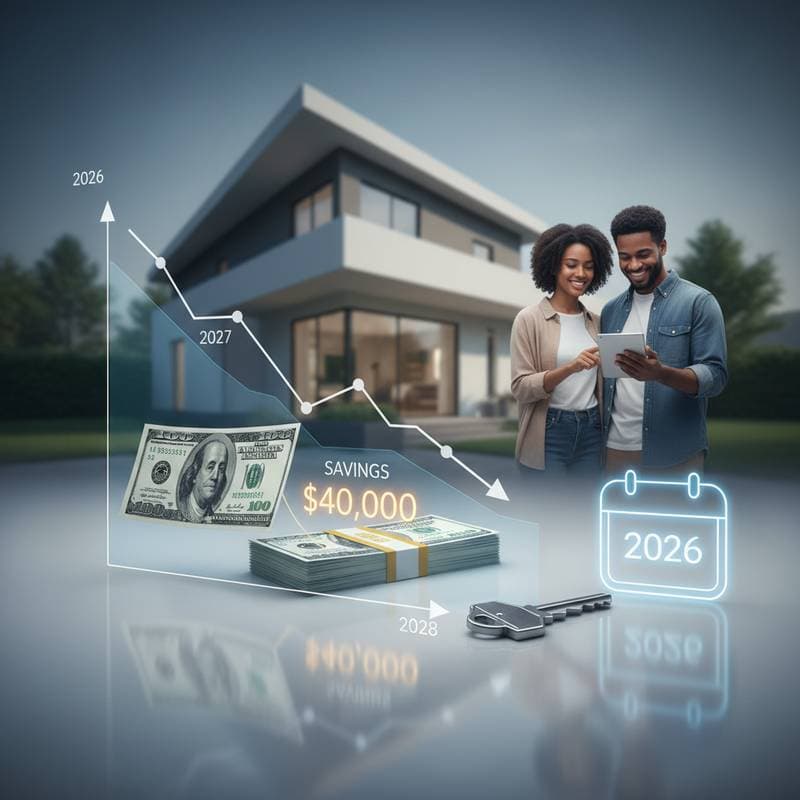
Save $40,000 on 2026 Mortgages Using a 2-1 Buydown
Homebuyers often face the challenge of balancing desired properties with affordable monthly payments. A 2-1 buydown addresses this by temporarily lowering interest rates for the initial years of the loan. This approach provides immediate relief and positions borrowers for long-term savings.
The structure involves reducing the interest rate by two percentage points in the first year and one percentage point in the second year, after which the loan reverts to its original rate. Such a buydown applies to conventional, FHA, or VA loans and requires funding through an escrow account. Borrowers gain time to stabilize finances before full payments begin.
Key Benefits in Practice
Consider a $500,000 loan at a 6.5 percent interest rate. With a 2-1 buydown, the effective rate drops to 4.5 percent in year one, reducing monthly principal and interest payments by approximately $1,000. In year two, the rate adjusts to 5.5 percent, yielding savings of about $500 per month.
Over these two years, total savings on payments alone approach $18,000. Should interest rates decline, refinancing before the third year could amplify savings to $40,000 or more by locking in a lower permanent rate. These funds support home improvements, debt reduction, or emergency reserves.
Navigating the 2026 Mortgage Landscape
Analysts predict a competitive lending environment in 2026, with incentives like buydowns becoming standard to accelerate sales. New construction projects frequently include these options in promotional offers. For existing homes, negotiation plays a central role.
Contact builders early to inquire about included 2-1 buydowns, which often cover the full cost. In resale scenarios, instruct real estate agents to propose seller contributions as concessions. Such arrangements typically range from $10,000 to $15,000 and prove more efficient than equivalent price reductions, benefiting all parties at closing.
Understanding Costs and Funding Sources
The buydown cost equates to roughly two percent of the loan amount, or $10,000 for a $500,000 mortgage. This upfront expense funds the interest differential deposited into escrow. Multiple parties may assume this responsibility.
- Builder contributions: Prevalent in developments to draw purchasers.
- Seller concessions: Integrated into purchase agreements for smoother transactions.
- Lender incentives: Offered through seasonal promotions or competitive bids.
- Borrower funding: Paid at closing for direct control over terms.
Regional lenders and credit unions may provide tailored programs. Request details on any available subsidies to minimize personal outlay.
Essential Considerations and Risks
While beneficial, a 2-1 buydown demands careful evaluation. The temporary nature means payments increase after year two, so qualify based on the full loan amount from the outset.
Verify funding commitments in writing to avoid discrepancies. Note that early refinancing returns unused escrow funds as principal reductions, aiding balance payoff. Select lenders experienced in buydowns to ensure accurate escrow management and compliance.
Create a payment projection spreadsheet outlining monthly obligations across the loan term. This tool facilitates budgeting and highlights the adjustment period.
Strategies for Maximizing Savings
Leverage the reduced payments to fortify financial health. Prioritize high-impact actions during this period.
- Establish an emergency fund covering three to six months of expenses.
- Accelerate repayment of high-interest debts to lower overall carrying costs.
- Implement energy-efficient upgrades, such as insulation or lighting, to cut utility bills.
- Allocate surplus toward future renovations, ensuring steady progress without strain.
Directing savings strategically transforms the buydown into a catalyst for broader stability.
Steps to Secure a 2-1 Buydown
Initiate discussions with potential lenders during pre-approval to assess buydown feasibility. Review loan estimates for clarity on costs and terms. Coordinate with agents and builders to incorporate incentives into offers.
Finalize agreements with documented funding sources. Post-closing, monitor escrow statements and prepare for the rate adjustment through proactive planning. This process equips borrowers to capitalize on the buydown's advantages fully.