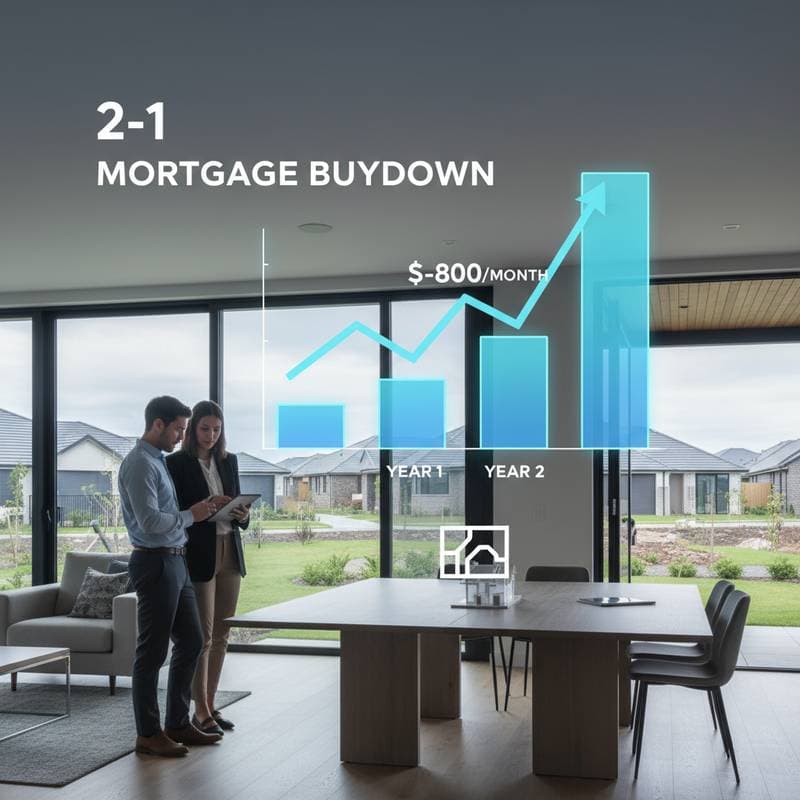
2-1 Buydowns: Reduce Monthly Mortgage Costs by $800
Imagine discovering the ideal home with a welcoming kitchen, ample backyard space, and a suitable neighborhood. Upon reviewing the mortgage details with a lender, the monthly payment exceeds expectations. In an environment of fluctuating rates, buyers seek strategies to manage payments effectively without compromising their choice.
Navigating the Financial Transition of a New Mortgage
Homeownership brings excitement alongside significant financial commitments. Buyers often balance desired properties against affordable monthly payments. Rate variations, even minor ones, substantially impact costs. For those extending budgets to secure preferred homes, initial months prove challenging.
A 2-1 buydown addresses this by offering temporary payment relief. This financing method lowers the interest rate for the early loan years, facilitating a gradual adjustment to homeownership expenses.
Understanding the 2-1 Buydown Structure
A 2-1 buydown reduces the interest rate by two percentage points during the first year and one percentage point in the second year. From the third year forward, the rate reverts to the original fixed note rate for the loan's duration. A lump sum funds the payment difference, typically provided by the builder, seller, or lender as an incentive.
Consider a fixed-rate mortgage at 6.5 percent. Under a 2-1 buydown, first-year payments calculate at 4.5 percent, second-year at 5.5 percent, and subsequent years at 6.5 percent. For a typical loan amount, this adjustment yields approximately $800 monthly savings in the first year.
These savings enable practical steps, such as furnishing the home or covering initial expenses, without additional debt.
Reasons for Increasing Popularity Among Buyers
Several factors contribute to the growing adoption of 2-1 buydowns:
- Defined payment progression. The structure outlines exact annual changes, eliminating uncertainty.
- Initial financial ease. Lower payments accommodate expenses like relocation, furnishings, or updates during settlement.
- Refinancing opportunities. Future rate declines allow refinancing prior to full-rate implementation.
- Incentive programs. Builders and lenders frequently cover costs to draw buyers, integrating buydowns into closing offers.
Regional builders often collaborate with lenders to provide 2-1 buydowns on specific properties, benefiting first-time buyers with essential early support.
Steps to Implement a 2-1 Buydown
Implementing a 2-1 buydown involves collaboration among the buyer, lender, builder, or seller. The process unfolds as follows:
- Initiate discussions promptly. Inquire with the lender about 2-1 buydown availability, including alternatives like 1-0 or 3-2-1 structures.
- Identify funding source. Confirm upfront payment coverage, commonly handled by builders as incentives or sellers as concessions.
- Examine terms thoroughly. Verify the rate timeline and payment impacts in detail.
- Prepare financial projections. Leverage reduced payments for stabilization while anticipating the full rate in year three.
Creating a spreadsheet to track payment escalations builds confidence in managing the transition.
Key Practical Aspects
Funding and Expenses
The buydown cost varies with loan size and rate differential, often equaling two to three percent of the loan amount. Builders typically include this in marketing efforts, delivering benefits to buyers at no extra charge.
Lenders such as Northstar Mortgage Group or HomeCity Lending may feature temporary buydowns in rate promotions. Request details during preapproval to ensure clear itemization in loan estimates and closing disclosures.
Leveraging Savings for Financial Improvement
Early-year reductions provide an opportunity to address other debts. Applying savings to eliminate a car loan, for instance, reduces overall obligations by the time full payments begin.
Alternatively, allocate funds to home enhancements, such as painting rooms in neutral tones or installing efficient lighting, personalizing the space affordably.
Market Timing and Strategic Planning
This option suits scenarios where rates exceed preferences yet delay home purchase seems undesirable. It enables immediate action with refinancing potential if conditions shift favorably. Monitor credit scores and home equity to position for optimal refinancing.
Frequently Asked Questions
Does a 2-1 buydown function like an adjustable-rate mortgage?
No. It applies to fixed-rate loans, with changes limited to the temporary buydown, not ongoing adjustments.
What occurs if refinancing precedes buydown completion?
Lenders may credit any remaining funds toward the principal, subject to specific policies.
Is combination with other incentives possible?
Yes. Builders commonly bundle buydowns with closing cost assistance or property upgrades in competitive markets.
Securing Your Path to Homeownership
A 2-1 buydown bridges current budget constraints and future stability, allowing adaptation without sacrificing ideal living arrangements. It transforms the homebuying process into a structured journey toward a secure, personalized residence. With strategic planning, the initial lower payments foster lasting financial confidence.