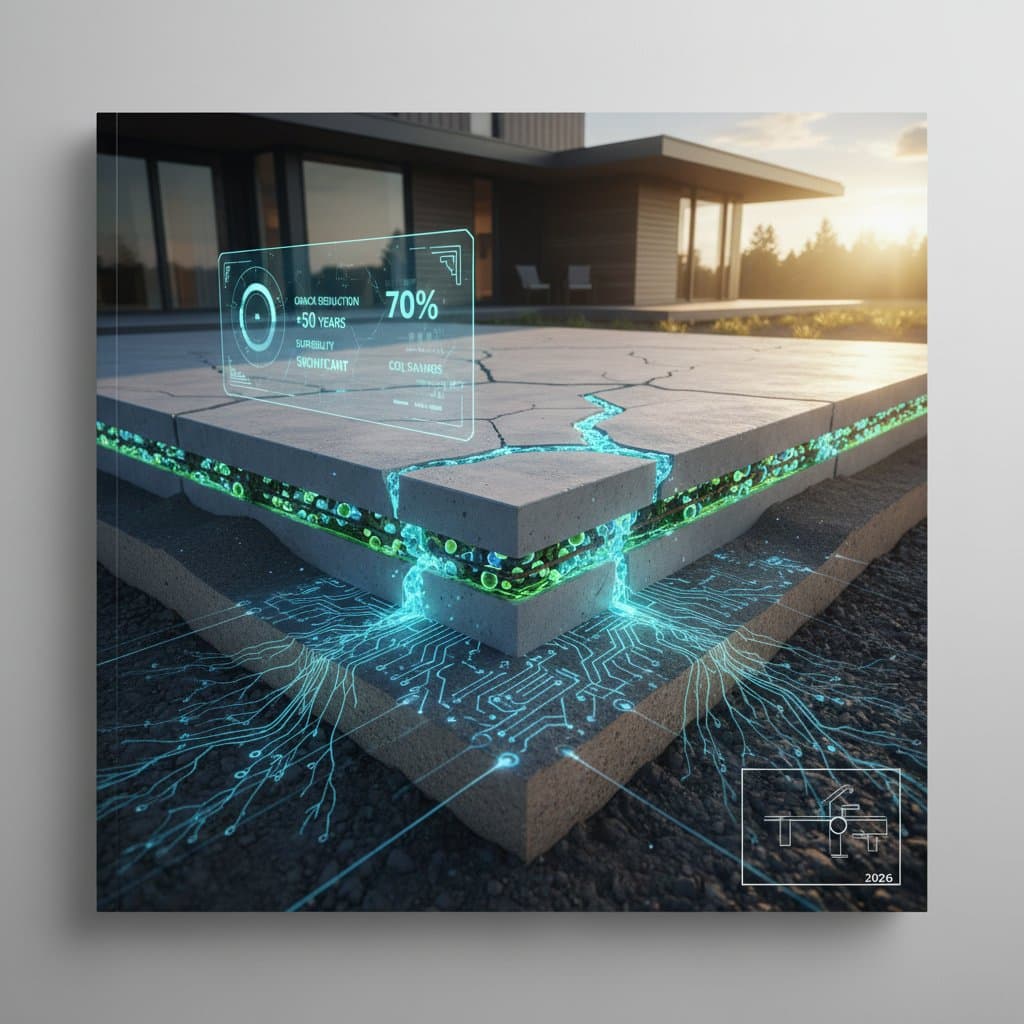
TL;DR
- Self-healing concrete transforms home foundation construction.
- Embedded bacteria enable autonomous crack sealing.
- Anticipate reduced repairs, extended service life, and significant cost efficiencies over time.
Why Builders View It as the Emerging Foundation Standard
Builders designate self-healing concrete as the forthcoming standard due to its capacity to minimize financial outlay, conserve time, and alleviate operational concerns.
Concrete inevitably develops cracks from factors such as thermal fluctuations, soil subsidence, or water exposure. These fissures typically necessitate costly interventions like sealant injections or patch applications. Self-healing concrete alters this paradigm by initiating repairs without external assistance.
The process integrates bacterial spores and nutrients into the concrete mixture. Upon crack formation, water activates the bacteria, which produce limestone to fill the void. This mechanism operates effectively for fissures up to 0.8 millimeters wide, restoring structural integrity autonomously.
Key Advantages
- Diminishes long-term maintenance expenditures by up to 70 percent.
- Sustains foundation robustness across multiple decades.
- Mitigates water infiltration and associated structural vulnerabilities.
- Supports environmental goals by curtailing waste from frequent repairs.
This enhanced concrete retains traditional attributes while incorporating adaptive capabilities, akin to a foundational element engineered for self-preservation.
Essential Considerations for Integrating Self-Healing Concrete in Home Construction
Address self-healing concrete as an advanced material rather than an infallible solution.
Although its reparative properties impress, vulnerabilities persist. Common oversights include the following:
-
Assuming complete maintenance exemption. The material addresses minor cracks, yet monitoring for substantial shifts or persistent water accumulation remains essential.
-
Selecting an incompatible bacterial formulation for local conditions. Bacterial strains vary; select those optimized for humidity levels, temperature ranges, or soil types prevalent in your area. Consult regional data to guide the builder's choice.
-
Neglecting adequate curing protocols. Adhere to standard timelines, typically 28 days, to allow full strength development. Premature loading risks compromising the bacterial activation.
-
Bypassing expert supervision. Engage contractors experienced in bio-based admixtures. Verify credentials through industry associations to ensure precise mixing ratios and application techniques.
By sidestepping these pitfalls, the foundation achieves optimal performance, safeguarding the structure proactively.
Tangible Benefits Observed in Daily Home Life
Examine the practical outcomes that enhance living experiences beyond theoretical projections.
-
Minimized surface imperfections. Interiors maintain aesthetic appeal with reduced visible fracturing on floors and walls, preserving a polished appearance in spaces like garages or basements.
-
Enhanced barrier against water penetration. Sealed cracks prevent subsurface moisture entry, thereby decreasing risks of mold proliferation and elevated indoor humidity.
-
Improved structural consistency. A stable base eliminates common annoyances such as creaking floors or misaligned fixtures, fostering a more serene environment.
-
Elevated property marketability. Prospective purchasers value durable, innovative features. Highlighting self-healing capabilities during sales can justify premium pricing and expedite transactions.
The fusion of technological sophistication and everyday utility resonates strongly, distinguishing properties in competitive markets.
Potential Limitations to Consider
Availability poses the primary challenge. Suppliers and contractors may lack familiarity with this technology, requiring targeted inquiries or partnerships with forward-thinking firms. Research local options through construction networks to identify reliable sources.
Additionally, while proficient with routine fissures, the material demands professional intervention for major failures stemming from seismic events or extreme loads. Position it as a robust ally for standard conditions rather than a universal remedy.
Initial costs exceed conventional concrete by 20 to 50 percent, depending on scale. However, lifecycle analyses demonstrate payback within five to ten years via repair avoidance.
Maintaining a Self-Healing Foundation Over Time
Post-installation, routine oversight suffices. Focus on peripheral elements to maximize efficacy.
Ensure proper site grading directs surface water away from the perimeter, ideally sloping at two percent. Install and maintain gutter systems to channel roof runoff effectively. Periodic inspections, conducted annually, verify drainage functionality and detect early anomalies.
Complement these practices with vegetation management to prevent root intrusion. Such measures empower the concrete's inherent resilience, extending its protective role indefinitely.
Frequently Asked Questions
Q: Is self-healing concrete suitable for driveways or patios?
A: Affirmative. Its durability suits exposed, load-bearing surfaces. Opt for formulations designed for outdoor exposure, incorporating UV-resistant bacteria to withstand elemental stresses.
Q: How does the bacterial healing process initiate?
A: Cracks permit water ingress, awakening dormant spores. The bacteria metabolize calcium lactate, generating calcite crystals that bond and seal the fracture within weeks.
Q: What is the expected lifespan compared to traditional concrete?
A: Foundations may endure 50 to 100 years with reduced degradation, versus 30 to 50 years for standard mixes under similar conditions.
Steps to Adopt Self-Healing Concrete in Your Project
Initiate by evaluating site-specific requirements through soil tests and climate assessments. Collaborate with certified builders to procure verified admixtures from reputable manufacturers. During planning, integrate cost-benefit projections to align with budgetary goals. Upon completion, document the installation for future reference, ensuring sustained performance and value realization.