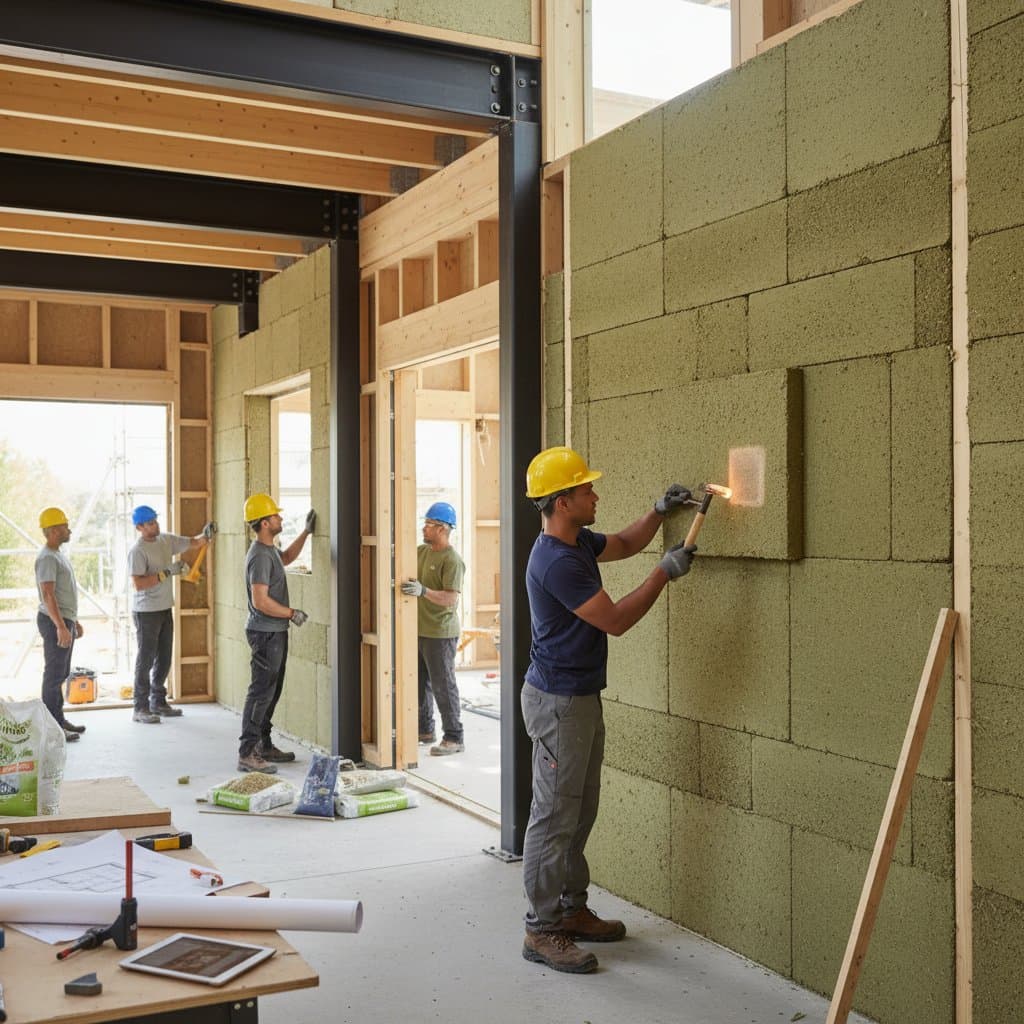
Understanding Hempcrete and Its Fire-Resistant Properties
Hempcrete emerges as a composite material crafted from the woody core of the hemp plant, lime, and water. This blend forms a lightweight, non-structural infill that integrates seamlessly into timber frames. Unlike traditional concrete, hempcrete possesses natural fire resistance due to its high lime content, which chars rather than burns when exposed to flames. This characteristic allows it to withstand temperatures up to 1,200 degrees Celsius for extended periods, providing a critical safety advantage in residential and commercial structures.
The material's composition contributes to its low thermal conductivity, making it an effective insulator. Builders select hempcrete for projects requiring both environmental responsibility and performance reliability. As awareness grows, architects incorporate it into diverse applications, from single-family homes to multi-unit developments, highlighting its versatility in modern design.
Key Benefits Driving Mainstream Adoption
Hempcrete stands out for its reduced carbon footprint compared to conventional cement-based products. Production of hempcrete sequesters carbon dioxide during the hemp plant's growth and the lime's curing process, resulting in a net-negative emissions profile. This aligns with global sustainability goals, appealing to developers focused on green certifications such as LEED.
In terms of indoor environmental quality, hempcrete regulates humidity naturally, preventing mold growth and maintaining comfortable moisture levels between 40 and 60 percent. Residents experience fewer allergens and improved air circulation, which enhances overall well-being. Energy efficiency further bolsters its appeal; the material's insulating properties can reduce heating and cooling demands by up to 30 percent, leading to substantial utility savings over time.
Structurally, hempcrete offers compressive strength suitable for load-bearing infill, while its flexibility absorbs minor seismic movements without cracking. These attributes make it ideal for regions prone to earthquakes or extreme weather. As building codes evolve to prioritize resilience, hempcrete gains traction in urban planning initiatives that emphasize durable, low-maintenance facades.
Common Mistakes to Avoid When Building with Hempcrete
Builders new to hempcrete often approach it with expectations derived from concrete handling, which leads to suboptimal results. The material requires a distinct methodology to maximize its benefits. Over-compaction during installation, for instance, compresses the hemp shiv and disrupts the porous structure essential for breathability and insulation.
Proper mixing and application demand attention to ratios and techniques. Use a volumetric ratio of approximately 1:1.5:1 for lime, hemp shiv, and water, adjusting slightly based on ambient humidity. Cast the mixture into forms using light tamping to achieve uniform density without eliminating air pockets. This process ensures the walls develop their full thermal and acoustic performance.
Essential Tips for Successful Hempcrete Construction
-
Determine Wall Dimensions in Advance: Select thicknesses ranging from 8 to 12 inches to optimize insulation values, typically achieving an R-value of 2.4 per inch. Account for these dimensions during the design phase to align window and door frames precisely, avoiding costly adjustments later.
-
Allow Ample Curing Time: Hempcrete cures through carbonation, a process that can span 4 to 6 weeks depending on ventilation and temperature. Maintain site conditions above 50 degrees Fahrenheit and ensure good airflow to accelerate hardening without artificial heat, which might cause uneven drying.
-
Select Compatible Binders: Opt for hydrated lime or natural hydraulic lime formulated for bio-based aggregates. Avoid Portland cement additives, as they introduce excessive rigidity and potential for shrinkage cracks. Test small batches to verify adhesion and workability before full-scale production.
-
Incorporate Protective Finishes: Apply lime-based renders or plasters externally to shield against weathering. Internally, breathable paints preserve the material's moisture-regulating function. These finishes enhance aesthetics while extending the lifespan beyond 100 years.
-
Train Your Team Thoroughly: Conduct hands-on workshops to familiarize workers with hempcrete's unique handling. This investment minimizes errors and boosts efficiency, particularly on larger projects where consistency proves crucial.
Experiencing Life in a Hempcrete Home
Daily life within hempcrete-enclosed spaces reveals subtle yet profound improvements. The walls absorb excess humidity during rainy seasons and release it in dry periods, fostering a stable microclimate. This natural regulation eliminates the need for constant mechanical dehumidification, contributing to lower operational costs.
Acoustically, the material dampens external noise effectively, creating serene interiors ideal for restful sleep or focused work. Temperature fluctuations remain minimal, with interiors maintaining even warmth that reduces reliance on HVAC systems. Over time, occupants report heightened comfort and a sense of connection to natural building principles.
Maintenance proves straightforward; periodic inspections for surface integrity suffice, as the material resists pests and rot inherently. This durability translates to fewer repairs and a stable property value, appealing to long-term homeowners and investors alike.
Frequently Asked Questions
Is hempcrete more costly than traditional materials? Initial expenses may exceed those of standard concrete by 10 to 20 percent due to specialized sourcing. However, lifetime savings from energy reductions and minimal upkeep often offset this premium within 5 to 7 years.
Does hempcrete suit all climate zones? It adapts well across varied environments, from coastal humidity to arid interiors. The lime component binds excess moisture, while the hemp provides capillary action to prevent waterlogging, ensuring performance in temperatures from -40 to 120 degrees Fahrenheit.
Can hempcrete support structural loads? As a non-load-bearing infill, it complements timber or steel frames. For enhanced strength, reinforce with mesh or fibers during casting, allowing integration into hybrid systems for multi-story applications.
How does hempcrete compare to other eco-materials like straw bale? Hempcrete offers superior fire resistance and faster installation, with less vulnerability to moisture damage. Its moldability suits curved designs, providing aesthetic flexibility absent in rigid alternatives.
Embracing Hempcrete for Sustainable Futures
Hempcrete transcends its origins as an experimental choice, emerging as a cornerstone of resilient architecture. By prioritizing safety, efficiency, and ecological harmony, it equips builders to meet escalating demands for innovative solutions. Consider integrating hempcrete into upcoming projects to realize structures that endure while nurturing the planet. This material not only constructs walls but builds a legacy of thoughtful, impactful design.