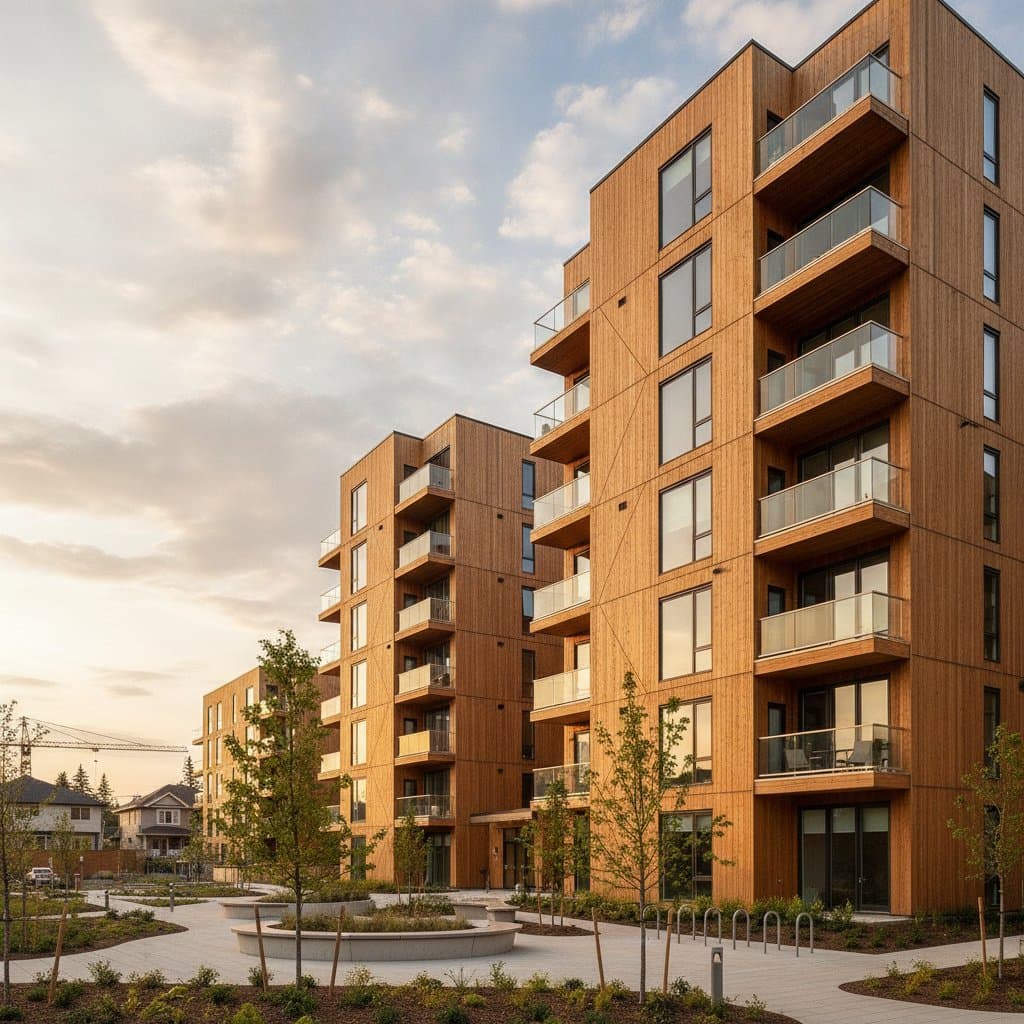
Key Points
- Cross-laminated timber enables mid-rise and high-rise construction in suburban settings with reduced build times and lower foundation requirements.
- Proper builder selection and moisture management ensure long-term performance comparable to traditional materials.
- Exposed CLT surfaces deliver natural aesthetics while supporting energy efficiency through thermal mass properties.
Understanding Cross-Laminated Timber
Cross-laminated timber consists of lumber layers glued perpendicular to one another. This configuration creates panels capable of supporting structural loads in buildings up to 18 stories. The material weighs approximately one-fifth as much as concrete, which allows smaller foundations and reduced site disturbance during construction.
Developers in suburban markets value the shorter assembly schedules. Crews can erect CLT structures in weeks rather than months because panels arrive prefabricated and require only mechanical connections on site. Residents notice the interior environment immediately. Wood surfaces maintain comfortable humidity levels and provide acoustic separation between units.
Design and Performance Advantages
Architects can specify visible CLT ceilings and walls to establish a warm interior palette. When paired with large glazing, the wood tones contrast effectively with metal accents and planted areas. Fire performance meets code requirements through charring behavior that protects inner layers during exposure.
Seismic regions benefit from the material ductility. Connections designed with energy dissipation allow buildings to flex without brittle failure. Thermal performance improves because wood conducts heat at a lower rate than steel or concrete, which reduces heating and cooling loads once the building is occupied.
Selecting an Experienced Builder
Request documentation of completed CLT projects that match the proposed height and climate zone. Verify the builder uses temporary weather protection during erection and applies edge sealing to all panel joints. Experienced teams coordinate with suppliers to sequence deliveries so that panels remain dry until permanent enclosure is complete.
Practical Considerations for Owners
Maintenance follows standard wood-frame protocols. Annual inspections of sealants around penetrations and periodic checks of roof drainage prevent moisture accumulation. Insurance providers now underwrite mass-timber buildings at rates similar to concrete structures when fire-suppression systems are installed.
Common Questions
Is CLT suitable for buildings over six stories?
Yes. Multiple projects worldwide have received permits for structures between eight and 18 stories when engineering calculations demonstrate adequate strength and fire resistance.
How does initial cost compare with concrete construction?
Material costs are often higher, yet total project expense frequently aligns because of shorter construction duration and reduced labor hours.
What climate conditions require extra attention?
Humid regions need robust flashing details and continuous ventilation behind exterior cladding. Cold climates benefit from the insulation value of thick panels that minimize thermal bridging.
Can single-family homes incorporate CLT?
Many fabricators now supply smaller panels for custom residences, offering the same exposed-wood aesthetic at a residential scale.
What is the expected service life?
With routine maintenance and protection from prolonged moisture, CLT buildings achieve lifespans equivalent to concrete or steel frames.
Evaluating CLT for Suburban Development
Project teams that prioritize schedule certainty and occupant comfort find CLT aligns with both goals. Early coordination between architect, structural engineer, and fabricator identifies connection details and weather-protection sequences that protect the investment over decades.