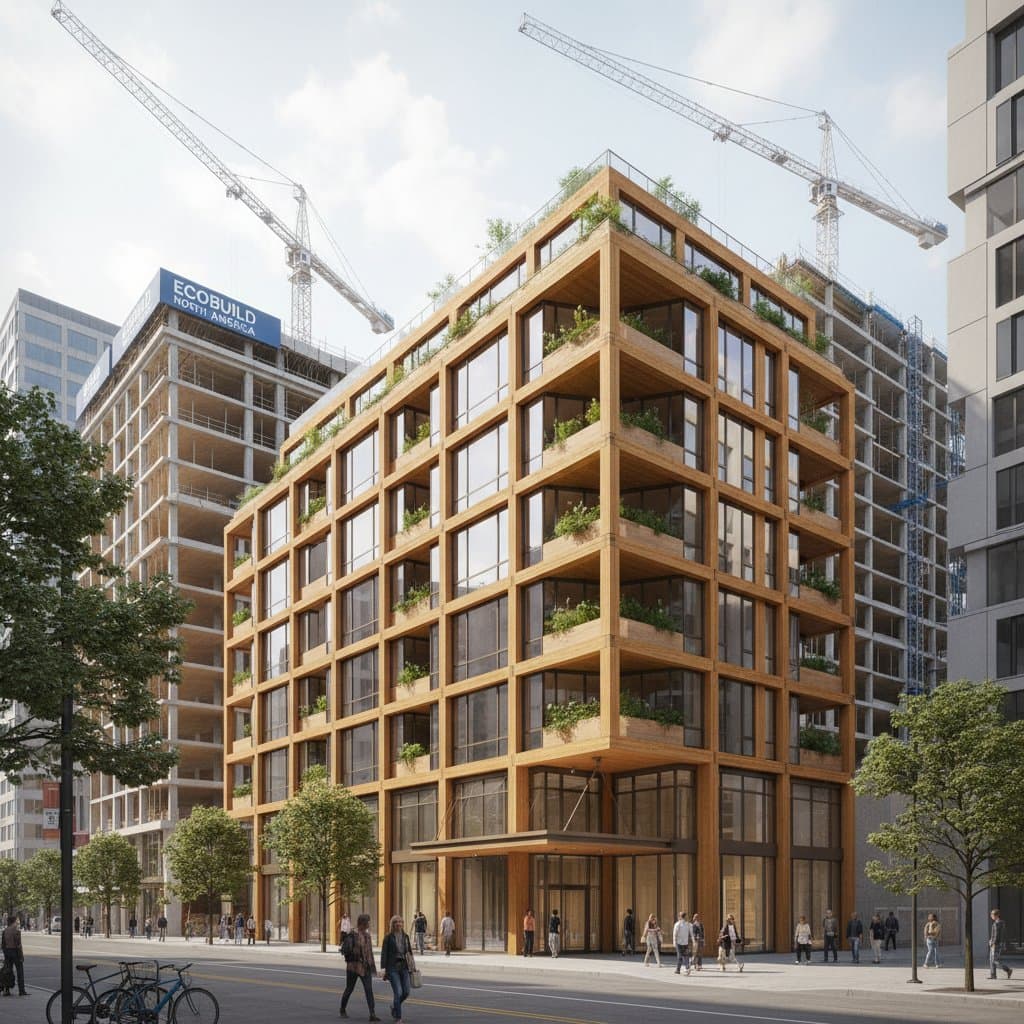
Eight-Story Mass Timber Structures Enter the Mainstream
Picture entering a lobby where warm wooden panels rise eight stories overhead. The atmosphere evokes serenity, similar to a forest after rainfall. This sensory experience distinguishes contemporary wooden buildings, rendering them vibrant, rooted, and profoundly human. The author recalls visiting the first mass timber edifice and recognizing that urban environments ought to embody such qualities.
Builders and architects once viewed tall wooden structures as unfeasible. Today, eight-story timber buildings emerge in cities nationwide, demonstrating that wood competes effectively with steel and concrete. Readers interested in the evolution of this trend or its implications for construction should take note.
Balancing Durability and Sustainability
Urban construction has historically navigated tensions between the robustness of steel and concrete versus the appeal and renewability of natural elements. Conventional materials offer reliability yet impose significant weight and carbon emissions. Wood provides renewability but faced height restrictions from fire regulations and structural limitations.
Engineered wood, particularly mass timber, alters this dynamic. Cross-laminated timber panels and glued-laminated beams allow architects to create multi-story designs that prove lightweight, resilient, and visually compelling. The key challenge involves integrating innovation with proven reliability. Skeptics question wood's endurance, yet ongoing projects affirm its viability.
Fundamentals of Mass Timber Construction
Mass timber differs from standard lumber through its composition of multiple wood layers compressed into expansive, solid panels. These panels serve as floors, walls, and roofs, yielding a material that matches the performance of conventional frameworks.
Key components include:
- Cross-Laminated Timber (CLT): Wood veneers arranged in perpendicular layers provide multidimensional strength and stability.
- Glued-Laminated Timber (Glulam) Beams: Layered and bonded wood forms beams capable of long spans with reduced mass.
- Nail-Laminated Timber (NLT): Dimensional lumber fastened via nails creates cost-effective options for floors and ceilings.
Mass timber excels in fire resistance. The exterior chars to create an insulating shield, preserving the core. This characteristic often enables timber elements to outperform unprotected steel in fire scenarios.
Engineering Eight-Story Designs
At eight stories, structural integrity demands precise handling of loads, wind forces, and acoustics alongside aesthetic warmth. Mass timber's adaptability shines here, permitting exposed elements for organic appeal or integration with concrete cores for reinforcement.
In renovation experiences, the author observed that light hues and textures enhance perceived height. Architects apply similar techniques with pale CLT panels to distribute natural light inward, countering visual density and illuminating interiors.
Standard configurations for eight-story mass timber buildings incorporate:
- Concrete bases and central cores for foundational support.
- CLT slabs for efficient, robust flooring.
- Glulam supports that contribute distinctive character.
- Steel fasteners ensuring secure interconnections.
This combined methodology controls expenses and facilitates regulatory approvals, particularly for inspectors less familiar with timber applications.
Economic and Assembly Factors
Initial perceptions suggest mass timber incurs higher costs, yet comprehensive analysis reveals equilibrium. Although per-unit material expenses exceed those of concrete marginally, accelerated erection offsets the difference. Factory-prefabricated components arrive onsite for swift installation, allowing teams to complete floors within days.
Consider these economic aspects:
- Material Expenses: CLT falls between moderate and elevated ranges relative to traditional framing.
- Labor Efficiencies: Reduced onsite personnel and timelines minimize rental or financing durations.
- Finishing Economies: Visible wood surfaces bypass requirements for gypsum board or coatings.
During a commercial retrofit involving CLT for an intermediate level, the team concluded the work in half the anticipated period. The owner appreciated the finish to such an extent that ceiling treatments became unnecessary.
Environmental Advantages and Sourcing Strategies
Mass timber gains traction due to its ecological profile. As a renewable resource, wood sequesters carbon instead of generating it. Responsibly harvested from sustainable forests, it ranks among the premier green building options.
Regional manufacturers now produce CLT and glulam, with leaders in the Pacific Northwest such as D.R. Johnson and SmartLam setting standards. Local procurement bolsters economies and curtails transport-related emissions. Projects thus achieve modernity alongside environmental stewardship.
Aesthetic and Habitational Enhancements
Occupants frequently characterize timber structures as tranquil. Wood's inherent texture tempers environments, rendering workplaces more welcoming and residences more livable. A stay in a timber hotel demonstrated this: despite external urban clamor, interiors maintained quietude through wood's superior sound absorption compared to concrete.
Innovative applications highlight the material:
- Exposed CLT enclosing open risers.
- Beams integrated as overhead illumination.
- Frames around windows that develop patina elegantly.
Such features underscore that superior design avoids sterility, embracing tactile warmth and natural ties.
Ensuring Safety and Upkeep
Discussions of eight-story wooden buildings invariably address safety. Mass timber complies with rigorous fire and earthquake standards. Installations typically feature suppression systems, rated junctions, and segmented layouts. The charring mechanism shields interiors akin to a protective outer layer.
Upkeep proves uncomplicated. Monitor humidity levels, examine connections periodically, and employ mild cleaners on visible surfaces. The author applies extended-reach tools for dark home areas, a method scalable to grander settings.
Advancing Timber Projects
The emergence of eight-story timber constructions marks a paradigm shift in building practices. Mass timber unites sustainability, efficiency, and elegance seamlessly. Developers benefit from compressed schedules, occupants from enhanced livability, and ecosystems from lowered emissions and prudent resource management.
For prospective endeavors, consult regional providers and CLT-experienced engineers. Tour existing installations to gauge material performance firsthand. Incorporate illumination, surface variety, and organic elements to elevate designs.
Beyond mere elevation, these structures reshape architectural essence: resilient, innate, and inherently humane. Mass timber transitions from novelty to norm.