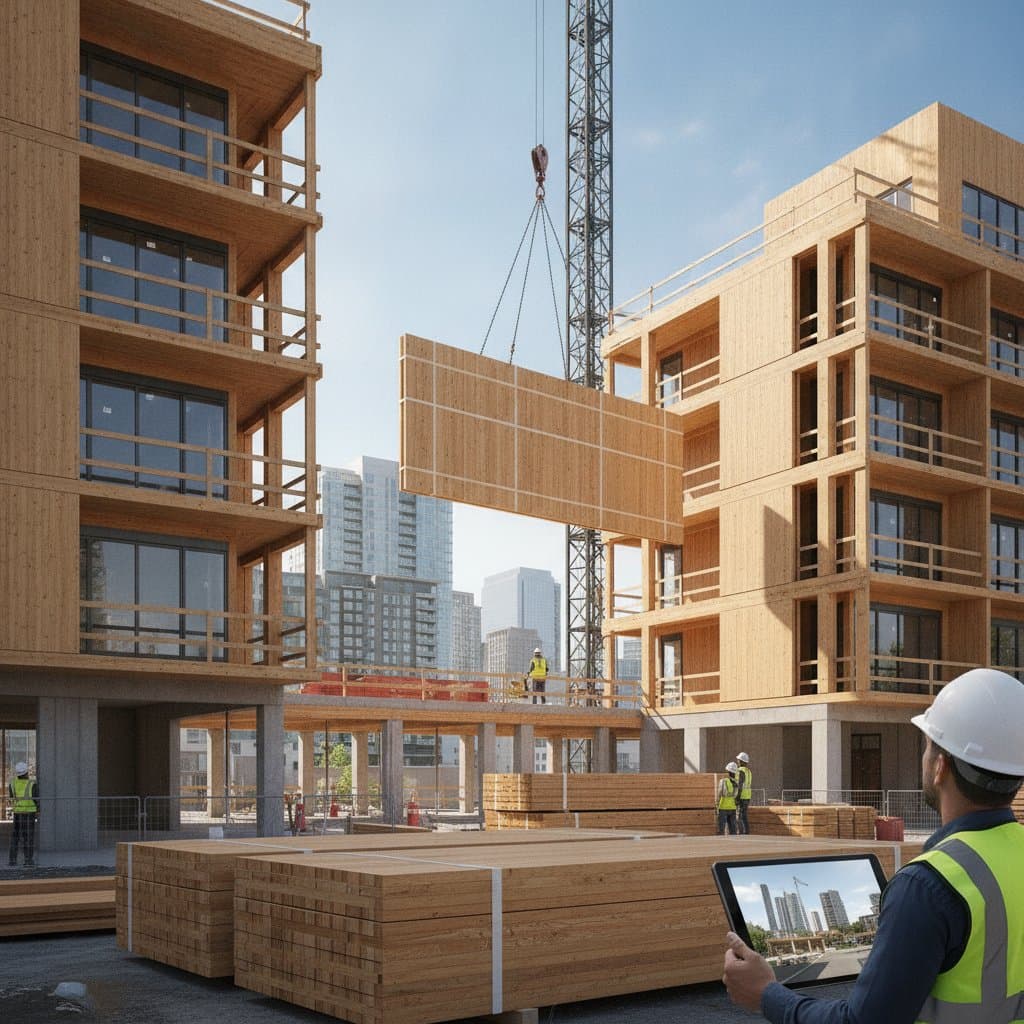
Mass Timber Construction Accelerates Project Delivery
Mass timber construction relies on prefabricated cross-laminated timber panels to shorten schedules and reduce on-site labor. Builders report project timelines shortened by as much as 40 percent compared with traditional concrete or steel methods. The approach combines factory precision with straightforward assembly sequences.
Core Advantages of Prefabricated Panels
- Factory cutting produces panels that arrive ready for immediate installation.
- Reduced weather exposure during erection protects both materials and schedules.
- Lighter structural weight allows smaller foundations and simpler crane operations.
- Natural wood surfaces often remain exposed, eliminating multiple finishing trades.
These characteristics translate into fewer variables on the job site. Crews spend less time coordinating sequential pours or welding sequences. Material waste drops because offcuts are managed at the fabrication plant.
Comparison With Conventional Systems
Concrete construction requires formwork, reinforcement placement, and curing periods that extend across multiple weeks per floor. Steel frames demand extensive bolting or welding followed by fireproofing applications. Mass timber panels, by contrast, are craned into position and fastened with screws or dowels in a single operation.
A mid-rise residential building that might require 18 months using concrete can reach substantial completion in 10 to 11 months with mass timber. The time savings compound when interior trades begin work sooner because the structure is already weather-tight.
Structural Performance and Safety
Cross-laminated timber panels undergo rigorous grading and testing before leaving the plant. Connections are engineered to transfer loads predictably during seismic or wind events. Fire performance meets code requirements through charring behavior that protects the inner core of each panel.
Third-party certification programs verify species, moisture content, and adhesive quality. These controls give designers confidence to specify longer spans and taller structures than earlier wood systems allowed.
Sustainability Metrics
Timber sequesters carbon throughout its service life. Substituting mass timber for concrete and steel reduces the embodied carbon of a typical office building by 20 to 30 percent. Local sourcing of softwood species further lowers transportation emissions.
At end of life, panels can be disassembled and reused or processed into particleboard and biofuel. This circular potential exceeds the disposal options available for reinforced concrete.
Implementation Steps for Project Teams
- Engage a mass timber supplier during schematic design to align panel sizes with architectural grids.
- Coordinate early with the structural engineer on connection details and erection sequencing.
- Schedule factory production to match foundation completion, avoiding storage delays.
- Train installation crews on proper lifting points and temporary bracing requirements.
- Verify moisture protection details at panel joints before enclosure.
These steps keep the schedule advantage intact from permitting through occupancy.
Practical Outcomes Observed on Recent Projects
Developers note that cleaner sites improve safety records and neighbor relations. Fewer deliveries reduce traffic impacts in urban locations. The visible wood aesthetic also supports marketing efforts aimed at tenants seeking biophilic environments.
Maintenance teams report straightforward inspection access to connections and services because mechanical runs are often routed in exposed ceiling cavities. This layout simplifies future renovations.
Next Actions for Interested Builders
Review current projects for floor plates that fit standard panel dimensions. Request preliminary pricing from regional fabricators to compare total installed costs. Pilot a single building type before scaling across a portfolio.