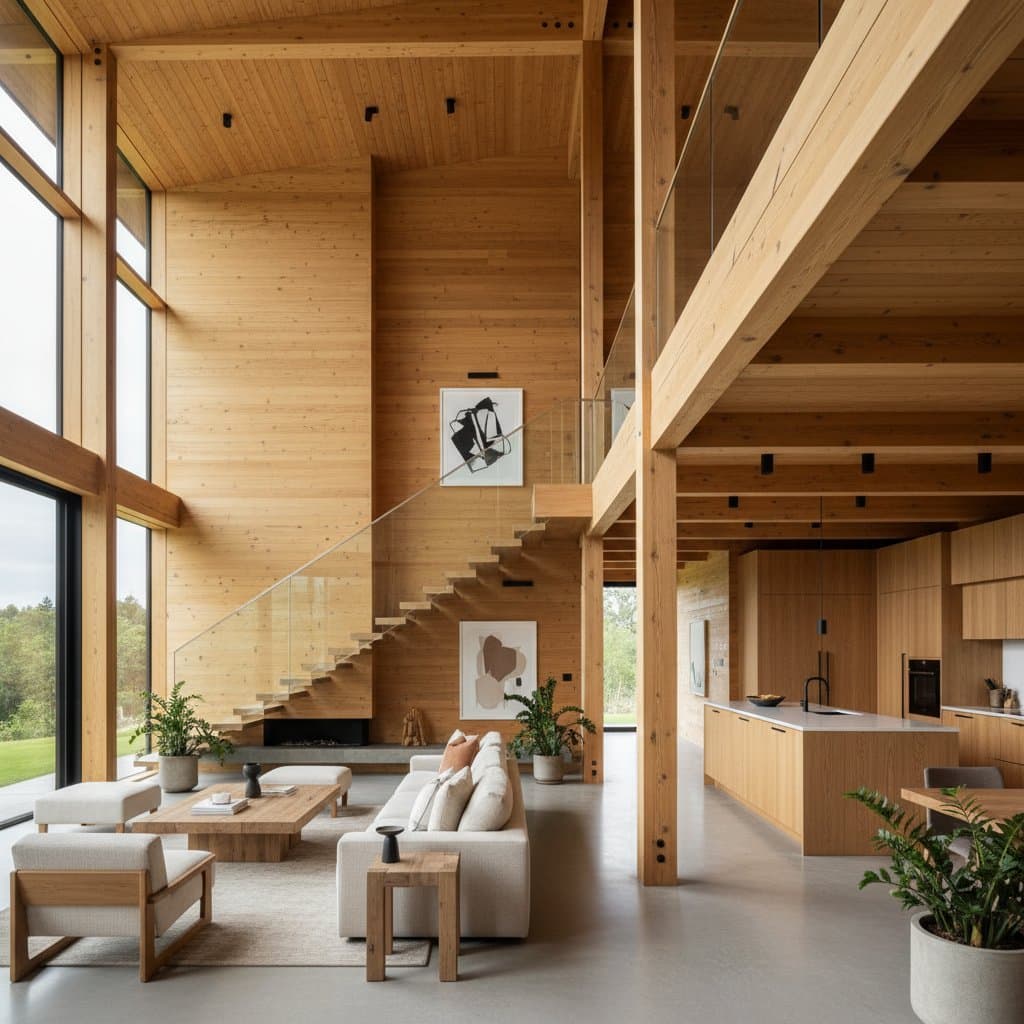
Mass Timber's Rise: The Leading Trend in 2025 Home Construction
Wood possesses an inherent ability to create grounded, inviting environments. This quality drives the current surge in mass timber construction, which elevates engineered wood to primary structural roles in residential projects. From secluded retreats to city dwellings, mass timber integrates timeless natural elements with contemporary architectural precision.
The material shifts beyond decorative use to form the core framework of buildings through products like cross laminated timber (CLT). This approach honors traditional craftsmanship while embracing innovative engineering, resulting in structures that balance environmental responsibility with modern functionality.
Understanding Mass Timber
Mass timber consists of large-scale engineered wood components, such as panels and beams, designed to substitute for conventional concrete or steel frameworks. Cross laminated timber, the predominant variant, involves gluing layers of lumber in perpendicular orientations under high pressure. This process yields panels that exhibit exceptional strength-to-weight ratios and dimensional stability.
Unlike raw lumber, these components feature smooth, factory-finished surfaces for seamless on-site assembly. Construction teams appreciate the reduced installation time compared to poured concrete. Residents value the tactile warmth and organic presence that distinguish wood from impersonal metals or aggregates.
Key Reasons for Its Popularity
Mass timber appeals through its alignment of ecological benefits and aesthetic versatility. Homeowners seek residences that harmonize with nature while adhering to rigorous performance criteria. Engineered wood maximizes resource efficiency by utilizing smaller-diameter trees and precise milling techniques, thereby minimizing deforestation and production waste.
The material sequesters carbon throughout its lifecycle, offsetting emissions associated with manufacturing. Architects leverage its workability to craft expansive, light-filled interiors with prominent structural elements. This versatility suits diverse settings, from rural escapes to dense urban developments, evoking a fusion of heritage and innovation.
Impacts on Construction Processes
Mass timber streamlines building workflows through off-site prefabrication. Components arrive pre-cut to specifications, enabling swift erection via cranes and minimal tooling. Projects that require extended curing periods with concrete often complete framing phases in weeks rather than months.
This method lowers overall expenses by curtailing labor hours and material surplus. It also mitigates site disturbances, preserving nearby ecosystems during development. Homeowners benefit from accelerated occupancy and enhanced project oversight, with the subtle aroma of fresh wood marking each assembly milestone.
The Experience of Residing in a Mass Timber Home
A mass timber residence offers sensory distinctions from standard constructions. Wood surfaces provide subtle texture and acoustic absorption, fostering serene atmospheres. Natural light interacts with the grain to produce evolving hues that enhance daily comfort.
The material naturally moderates indoor humidity levels, promoting stable microclimates year-round. A mild, earthy fragrance permeates the air, contributing to a refreshed ambiance. These attributes extend beyond visuals to create spaces that feel inherently nurturing.
Suitability Across Climates
Mass timber adapts effectively to varied environmental conditions when engineered appropriately. In moisture-prone regions, treatments and sealants safeguard against water ingress, complemented by design features like extended eaves and robust joint protections. Proper airflow systems further ensure longevity.
In temperate or frigid zones, the inherent thermal mass of wood retains heat efficiently, reducing energy demands for climate control. Panels integrate seamlessly with insulation layers to maintain consistent interior temperatures. Builders confirm that well-detailed installations withstand extreme weather without compromising integrity.
Mass Timber Versus Conventional Materials
Evaluating mass timber against established options highlights its advantages.
Concrete and Steel
- Provide proven durability yet demand substantial energy for extraction and fabrication.
- Involve cumbersome transport and prolonged assembly, yielding cooler, less engaging interiors.
Mass Timber (CLT and Glulam Variants)
- Derive from replenishable sources, weigh less, and assemble rapidly.
- Deliver inviting, sensory-rich finishes while capturing atmospheric carbon.
- Support lower operational costs through superior insulation and reduced upkeep.
Availability influences material selection in certain locales, though expanding production facilities narrow cost disparities. Long-term analyses often favor timber for its holistic economic and ecological returns.
Evolving Design Approaches with Mass Timber
Mass timber inspires architectural expressions that emphasize material authenticity. Exposed elements replace concealed framing, turning structural components into focal points. This transparency infuses spaces with warmth and narrative depth.
Prominent trends include:
- Modern Rustic: Sleek profiles alongside raw wood textures, accented by neutral metals.
- Scandinavian Minimalism: Light-toned timbers in fluid plans, enhanced by diffused illumination.
- Urban Loft Style: Wood paired with metallic elements for a refined industrial vibe.
- Eco-Contemporary: Timber frameworks supporting biophilic integrations like expansive glazing.
Cohesive detailing, such as matching cabinetry or railings, amplifies unity. Designers recommend contrasting textures to avoid visual overload, ensuring balanced and airy compositions.
Essential Guidance for Mass Timber Projects
Prospective builders should prioritize these strategies for successful implementation.
- Select Specialized Professionals: Engage firms proficient in CLT handling and connection techniques to optimize outcomes.
- Embrace Prefabrication Planning: Lock in blueprints early to facilitate factory precision and streamline logistics.
- Address Environmental Factors: Collaborate on protective measures tailored to regional conditions, including barrier applications.
- Allocate Resources Strategically: Account for initial premiums offset by efficiencies in scheduling and utilities.
- Establish Care Routines: Apply periodic finishes to visible areas, monitoring for environmental shifts to preserve vibrancy.
Broader Implications for Sustainability
Mass timber advances eco-centric building by diminishing reliance on high-emission processes. It encourages holistic designs incorporating renewables like photovoltaic systems and passive airflow. Such integrations yield residences that minimize ecological strain while maximizing inhabitant well-being.
This material revives connections to natural origins, embedding forest-derived resilience into urban fabrics. Builders increasingly pair it with regenerative practices, demonstrating that forward-thinking construction enhances both planetary health and personal sanctuary.
Sustaining the Timber Aesthetic Over Time
Mass timber homes evolve gracefully, with patinas developing through use and exposure. Gentle maintenance preserves these qualities: opt for eco-friendly finishes, regulate moisture, and employ non-abrasive cleaning. Periodic renewals restore original luster, ensuring enduring appeal without structural interventions.
The result is a living environment that matures alongside its occupants, offering tangible links to nature amid modern demands.