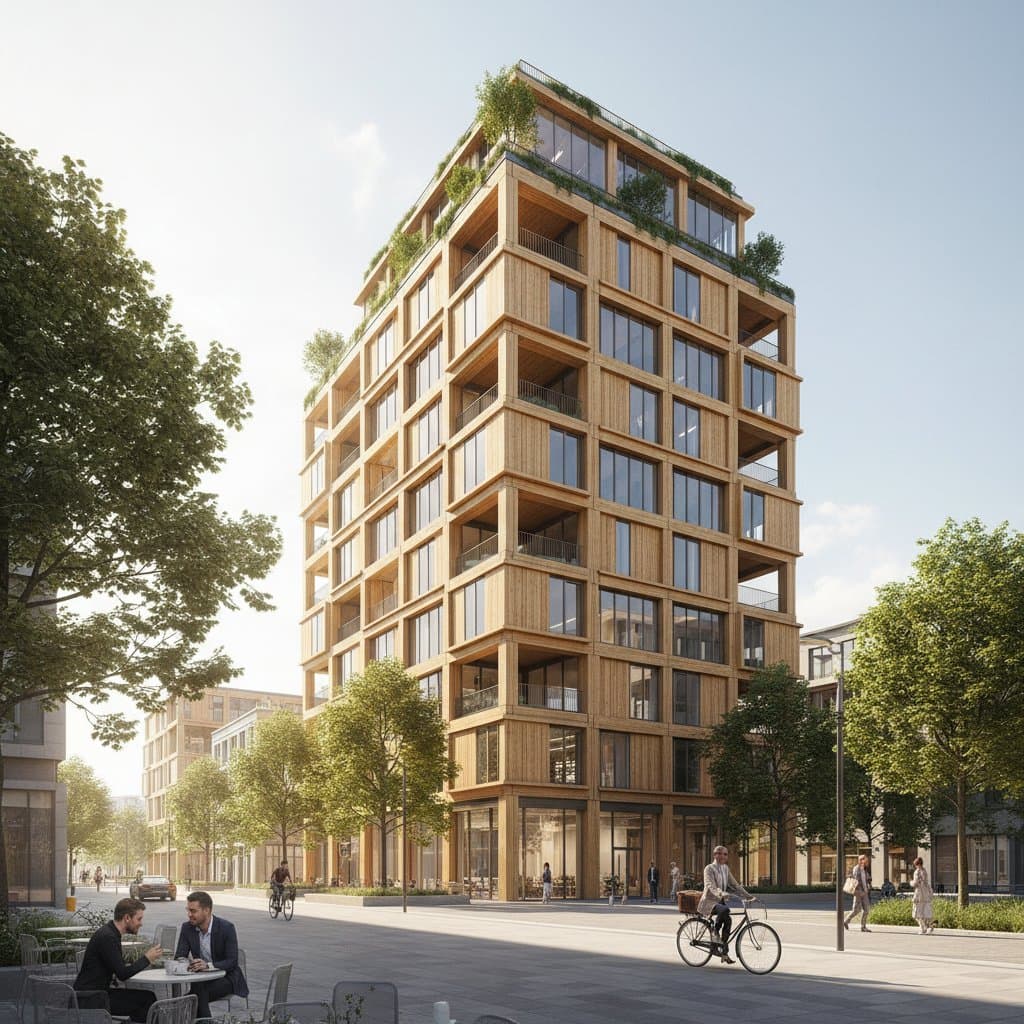
Mass Timber Era: 12-Story Wood Buildings Now Permitted
A small café constructed with exposed timber beams offers a glimpse into evolving architecture. The walls provide a tactile warmth, and the air holds a subtle pine aroma. This modern structure combines sleek glass and precise lines with an inherent sense of tranquility that steel and concrete seldom achieve. Such buildings signal a transformation in construction materials, one that warrants close attention.
Defining Mass Timber
Mass timber consists of large, engineered wood panels designed for structural applications. These panels form through layering wood veneers or lumber, bonded under pressure to create robust elements. Cross-laminated timber, or CLT, represents the predominant variety, with boards arranged in perpendicular layers to enhance stability and load-bearing capacity.
Manufacturing occurs in controlled factory settings, which minimizes defects like warping or cracking common in conventional lumber. Mass timber panels demonstrate superior fire resistance compared to initial assumptions and serve as viable alternatives to steel or concrete in floors, walls, and beams. This material balances exceptional strength with an organic aesthetic that maintains a connection to natural origins.
Significance of Permitting 12-Story Structures
Building regulations previously capped wood-frame heights at lower levels, restricting innovative designs. Recent code updates now authorize mass timber constructions up to twelve stories, enabling sustainable urban expansion without reliance on impersonal high-rises.
Visualize mid-rise residential towers that emit a soft glow at dusk rather than harsh reflections. The wood's grain introduces visual interest, texture, and inviting warmth to city skylines. For occupants, these spaces foster a sense of stability and comfort, distinct from sterile industrial environments.
This regulatory evolution reflects growing trust in timber's engineering merits. Rigorous evaluations confirm its performance in fire resistance, sound insulation, and earthquake resilience. The integration of advanced science with aesthetic appeal marks the onset of a transformative period in building practices.
Sustainability Advantages of Mass Timber
Mass timber derives from renewable sources, sourced from certified forests that regenerate harvested trees. Each panel sequesters carbon dioxide absorbed during the tree's growth, preventing atmospheric release that might occur through decay or combustion.
In contrast, producing concrete and steel demands substantial energy through high-temperature processes, generating significant emissions. Mass timber projects typically achieve 45 to 65 percent lower embodied carbon footprints. The material's reduced weight allows for shallower foundations, conserving additional resources and simplifying site preparation.
This approach embodies forward-thinking stewardship. Structures not only endure but actively contribute to carbon storage over their lifespan, aligning development with environmental preservation.
Aesthetic and Sensory Qualities of Timber Interiors
Entering a mass timber building reveals expansive ceilings showcasing wide planks with natural knots and tonal variations. Ambient light interacts with the surfaces to produce a diffused, warm illumination. In expansive offices or residences, the environment promotes serenity and focus.
Biophilic design principles emphasize nature's integration via organic materials and natural lighting, which timber facilitates effortlessly. The inherent patterns reduce the need for elaborate ornamentation, as the structure itself conveys depth and vitality.
To enhance such spaces, incorporate elements like neutral fabrics, minimalist hardware, or polished concrete accents. Timber harmonizes these components, creating balanced and restorative interiors suitable for diverse uses, from urban dwellings to professional settings.
Construction Adaptations for Mass Timber
Builders manage large panels through off-site prefabrication, where components arrive assembly-ready to streamline on-site work. This method accelerates timelines by up to 30 percent and minimizes disruptions in dense urban areas.
Panels interlock with precision-engineered joints, resembling interlocking components in a well-crafted assembly. The resulting framework offers structural integrity alongside acoustic benefits, as timber inherently absorbs vibrations for quieter interiors.
Specialized teams address challenges like moisture control and secure fastening to avoid issues such as expansion or voids. With accumulating project experience, professionals report that timber handling integrates seamlessly into workflows, fostering efficiency and reliability.
Addressing Fire Safety and Structural Integrity
Concerns about tall timber buildings often center on fire risks, yet mass timber's behavior under heat provides reassurance. Large sections develop a protective char layer that insulates the unburned core, maintaining load capacity longer than some steel assemblies in intense fires.
Independent testing verifies compliance with stringent codes, frequently surpassing benchmarks. Integrated sprinklers and intumescent coatings further mitigate hazards, emphasizing proactive design over risk avoidance.
Structurally, CLT distributes forces uniformly, permitting column-free spans up to 40 feet and versatile floor plans. This capability enhances spatial adaptability while upholding rigorous safety standards.
Implications for Urban Development and Community Life
City planners view mass timber as a tool to infuse warmth into evolving landscapes. Mid-rise developments promote walkable, human-centered environments over towering monoliths, supporting mixed-use vitality.
Public facilities like educational institutions and civic centers increasingly adopt CLT, yielding spaces that elevate user well-being through natural ambiance. Studies indicate improved cognitive function and satisfaction in such settings.
Envision community hubs with exposed timber framing bathed in soft daylight, or residential blocks that mirror surrounding greenery. This synergy between constructed and natural elements cultivates cohesive, appealing urban fabrics.
Key Factors in Mass Timber Projects
Prospective builders should evaluate costs, where initial panel expenses may exceed traditional options but yield savings via expedited labor and optimized foundations. Prefabrication curtails material waste by 20 to 30 percent, balancing the budget.
Regional climate influences suitability; timber thrives in varied conditions with vigilant humidity management during erection. Durable sealants and airflow systems ensure longevity exceeding 50 years.
Successful ventures hinge on interdisciplinary teamwork among designers, structural experts, and material providers. Early planning tailors solutions to site-specific demands, mitigating potential delays.
Embracing Timber's Enduring Appeal
Mass timber evolves gracefully, with surfaces acquiring richer hues and subtle patinas over years of exposure. These changes narrate the building's history, contrasting with synthetic alternatives prone to degradation.
Maintenance involves monitoring indoor climate, applying gentle cleaning agents, and celebrating organic textures. Seasonal shifts subtly influence the material, enhancing its dynamic presence.
In demanding environments, minor damages repair easily through sanding or refinishing, preserving authenticity. Timber's resilience underscores its role as a vital, adaptable choice in contemporary design.
Advancing with Mass Timber
Permitting twelve-story timber structures reshapes not only regulations but also perceptions of viable materials. Strength emerges from forest-sourced elements, meticulously engineered for endurance.
Architects and developers stand to benefit by examining existing installations, assessing tactile qualities, and integrating timber's attributes. From modest residences to city-scale initiatives, opportunities abound for innovative expression.
This era prioritizes intelligent construction that sustains ecosystems, fosters human connection, and honors natural resilience. Mass timber paves the way for architecture that endures with purpose and grace.