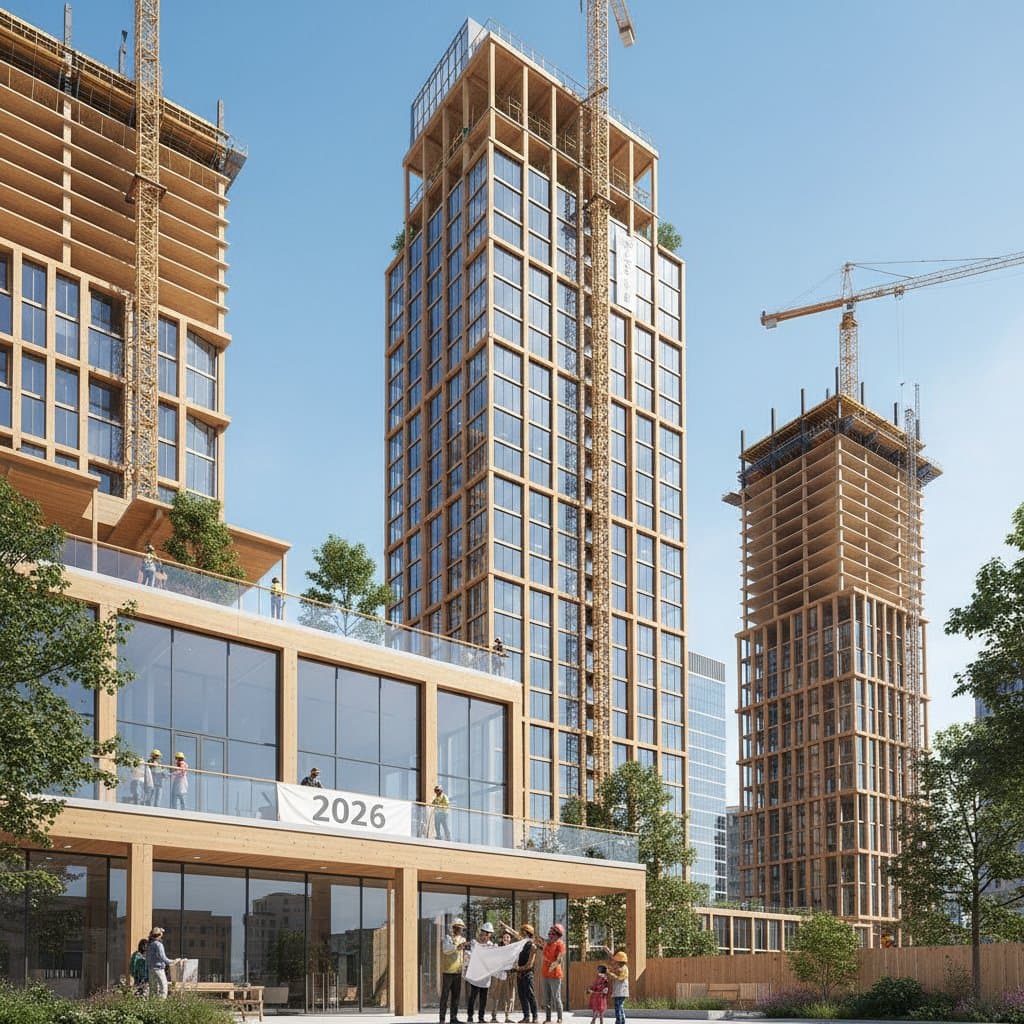
Summary
- New 2026 building codes expand the permissible height for mass timber structures, facilitating safer and more efficient high-rise developments.
- Cross-laminated timber emerges as a key material, offering strength comparable to traditional steel and concrete frameworks.
- Stakeholders including builders, designers, and property owners experience advantages such as reduced construction timelines and lower environmental impact.
Understanding Mass Timber
Mass timber consists of engineered wood products formed from large panels or beams that undergo gluing, nailing, or lamination processes. Cross-laminated timber, or CLT, represents a primary example. Manufacturers create CLT by stacking lumber boards in perpendicular layers, which results in panels that provide exceptional structural integrity and relatively low weight.
Professionals often compare CLT to an advanced version of plywood designed for load-bearing applications. Factories produce these panels with precise dimensions, allowing for efficient on-site assembly similar to constructing with modular components. Inside a completed CLT structure, occupants encounter the inviting texture and aroma of natural wood, yet the material delivers stability on par with concrete reinforcements.
This engineering approach addresses historical limitations of wood in construction. Earlier wood-based buildings faced constraints in scale due to concerns over durability and fire resistance. Modern mass timber resolves these issues through rigorous testing and standardized production methods.
The Appeal of CLT in High-Rise Construction
CLT high-rises capture attention for their aesthetic qualities, rapid assembly processes, and enhanced occupant comfort. While steel and concrete remain viable for certain projects, CLT introduces a sense of organic warmth absent in many contemporary structures.
Key distinctions of mass timber include the following:
- Construction Efficiency: Prefabricated panels arrive at the site in large sections, minimizing labor hours and operational disruptions.
- Fire Performance: Recent evaluations demonstrate that CLT develops a protective char layer during exposure to flames, preserving the unburned core and maintaining structural load capacity for extended periods.
- Environmental Benefits: Trees used in production sequester carbon dioxide, which remains locked in the material throughout its lifecycle, thereby offsetting emissions associated with manufacturing alternatives like cement.
- Architectural Versatility: Visible timber elements enable creative expressions through varied grains and finishes, fostering spaces that resonate with users on sensory levels.
During a visit to an under-construction CLT building, one observes the serene environment despite ongoing activities. Crews install panels with precision, generating far less dust and vibration than conventional methods. This efficiency translates to projects completing weeks or months ahead of schedule, a critical factor in dense urban settings.
Impact of the 2026 Building Codes
The forthcoming 2026 codes introduce specific allowances for mass timber, raising height limits from previous restrictions. Previously, many jurisdictions capped wood-framed buildings at around 10 stories due to seismic and fire safety protocols. These updates, informed by extensive research from organizations like the International Code Council, now permit structures up to 18 stories or more in approved zones.
Engineers must adhere to enhanced detailing requirements, such as integrated fire-stopping systems and connection hardware rated for high loads. These provisions ensure compliance while unlocking potential for widespread adoption. For instance, projects in seismic areas incorporate damping mechanisms within timber joints to mitigate earthquake forces effectively.
Builders benefit from streamlined permitting processes under the new framework. Local authorities provide clearer guidelines, reducing review times and encouraging innovation. As a result, cities anticipate a surge in proposals for mixed-use developments featuring mass timber cores surrounded by glass facades.
Practical Applications and Considerations
Mass timber suits a range of projects beyond skyscrapers, including office towers, residential complexes, and hybrid buildings. In residential settings, CLT panels serve as both structural walls and finished interiors, eliminating the need for additional drywall layers. This integration cuts material costs and accelerates move-in readiness.
Designers leverage CLT's acoustic properties to create quieter interiors. The material naturally dampens sound transmission between floors, an advantage in multifamily housing. Moreover, its thermal mass helps regulate indoor temperatures, potentially lowering energy demands for heating and cooling.
Sourcing remains a vital aspect. Reputable suppliers certify timber from sustainably managed forests, ensuring traceability and minimal ecological disruption. Builders evaluate local availability to optimize logistics, as transportation distances influence overall project economics.
Frequently Asked Questions
Question: How does mass timber perform in fire scenarios?
Thick CLT panels generate a char layer when exposed to heat, which insulates the interior wood and slows combustion. Independent tests confirm that these structures retain integrity for hours, exceeding minimum code requirements and allowing safe evacuation times.
Question: What are the cost implications of using mass timber?
Initial material expenses may exceed those of steel by 10 to 20 percent, depending on market conditions. However, savings from reduced labor, equipment rental, and site management often offset this premium, yielding total costs competitive with traditional methods over the project duration.
Question: Are there limitations on where mass timber can be applied?
Applications depend on regional regulations and climate factors. While the 2026 codes broaden approvals in North America and Europe, tropical areas require treatments against humidity and pests. Ongoing international harmonization efforts expand viable locations globally.
Question: How does mass timber contribute to sustainability goals?
Production emits up to 45 percent less carbon than concrete equivalents, per lifecycle analyses. Additionally, renewable sourcing supports forest regeneration, creating a virtuous cycle for environmental stewardship in the building sector.
Advancing Sustainable Urban Futures with Mass Timber
The integration of mass timber into high-rises promises denser, greener cities without sacrificing safety or style. Developers who adopt these materials position projects to meet rising demands for low-carbon infrastructure. Communities gain vibrant neighborhoods where natural elements enhance daily life.
Professionals interested in implementation should consult certified engineers early in planning. Resources from industry associations offer templates for code-compliant designs. As adoption grows, mass timber will shape skylines that balance progress with planetary health.